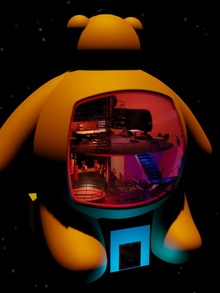
Reflections on the concept of «cozy living» and its evolution within philosophical and literary traditions. The text traces how perceptions of a «good» life have changed over the centuries, concluding that contemporary ideals of comfort and harmony present a peculiar internal contradiction.
Beginning with Rousseau’s sentimental utopia—where a comfortable existence was built upon rational hedonism and moral refinement within an idyllic estate—and moving through the Romantic belief in progress as a path to overcoming alienation, to the Marxist understanding of alienation as a fundamental social issue—all these concepts, according to the author, ultimately lead us to the contemporary situation where dreams of a comfortable life have become possible only through the maintenance of general malaise.
Of particular interest is the transition from classical theories of alienation, where it was understood as a socio-economic problem of labor exploitation, to modern, psychologized versions, such as Rachel Yeghie’s concept. Today, alienation is less an objective condition of the working class and more a subjective experience of dissonance between how a person feels about themselves and the roles they must play in society. The modern response to this problem is not a revolutionary transformation of society, but a specific kind of «generous appropriation”—a psychological adaptation that allows a person to accept even the most unpleasant aspects of life as a given.
However, this apparent harmony comes at a steep price. The modern ideal of a cozy life is only possible as an island of comfort in a sea of general hardship.
We have learned to create personalized zones of psychological comfort for ourselves, but this does not solve the systemic problems of society. Moreover, the very possibility of such partial coziness depends on the persistence of global inequality and the progress that simultaneously provides us with the means for a comfortable life while creating new forms of alienation. This is the paradox of the modern situation: the more we strive for personal comfort, the more we become dependent on the continuation of an uncomfortable world overall.
It appears that the evolution of ideas about a comfortable life has led us to a peculiar impasse. We have moved from sentimental dreams of universal harmony to a situation where the comfort of some is only possible through the preservation of the discomfort of others—where individual well-being is built upon a foundation of general dissatisfaction. Whereas utopias once offered at least illusory projects of universal happiness, modern concepts essentially renounce that task, instead proposing strategies for individual adaptation to an uncomfortable reality.
1. Sentimental Utopia: «Dictatorship of the Heart»
In the article, Mikirtumov presents an in-depth analysis of the utopian model of the «good life» in Jean-Jacques Rousseau’s novel, Julie, or the New Heloise. The author focuses on unraveling the contradictory nature of this concept, demonstrating how the idealized vision of harmonious existence coexists with the social conventions of the Enlightenment era.
The image of Julie occupies a central role in the study—she is a «beautiful soul» whose happiness is founded on virtue, moderation, and care for others. Mikirtumov emphasizes that Rousseau constructs an idealized depiction of a patriarchal system where landowners, like the Vollmars, exhibit a «paternal» care for the peasants, yet rigidly maintain class boundaries. Within this context, the author highlights three key components of Rousseauvian virtue: innate heartfelt kindness, the rhetorical power of persuasion, and conscious goodwill.
Analyzing the internal contradictions of Rousseau’s model, Mikirtumov shows that despite the declared ideals of naturalness and freedom, this concept proves to be elitist and conservative, founded upon class privileges.
This is especially evident in the interpretation of the relationship between Volmar and the peasantry, where the article’s author notes elements of sentimental idealization of patriarchal relations. At the same time, Mikirtumov consistently critiques the utopian nature of Rousseau’s project, pointing to the lack of concrete socioeconomic mechanisms for realizing the described idyll—which, in his view, remains more of an aesthetic ideal than a practical program.
Nevertheless, the author acknowledges the significant influence of this concept on the subsequent literary tradition, tracing its echoes in the works of Jane Austen and even in the image of Pushkin’s Tatyana.
The article presents a particular interest in its analysis of the gender aspect: Mikirtumov examines how Rousseau casts Julia in the role of a bearer of moral ideals—a role that transforms in the Romantic tradition into the abstract symbol of «sublime femininity, ” devoid of actual social agency.
Despite its utopian nature and internal contradictions, Rousseau’s concept exerted a significant influence on European culture, proposing an emotionally appealing—though politically naive—ideal of harmonious existence founded on virtue and „natural“ feelings.
This synthesis of idealized harmony and societal contradictions, as Mikirtumov demonstrates, positions Rousseau’s utopia as a characteristic product of the Enlightenment, an era where philosophical ideals intersected with tangible social structures.
Moments of Veracity. The Sensual Painting of Alexey Chernigin
Alexey Chernigin. «Atlantic Ocean, ” 2013.
Alexey Chernigin, son of the renowned Russian artist Alexander Chernigin. He imbues his canvases with the poetry of moments, where beauty and romance intertwine with emotional sincerity. His works are a hymn to femininity, embodied in sensual, unadorned figures. With virtuosic delicacy, the artist unveils the inner world of his heroines: their natural grace, the fluidity of their lines, and the spirit in their gestures create a bridge between reality and the ideal. Even in the genre of nude, Chernigin avoids artificiality, transforming nudity into a symbol of pure harmony, where naturalness borders on the sublime.
Despite the density of the oil strokes in his paintings, a sense of lightness prevails: the blue-green tones, the transparency of watercolor transitions, and the airiness of the background create the illusion of suspended time. The viewer seems to enter a space where the «pendulum of the clock» has frozen, allowing one to feel the fragility of «the thin thread between two eternities”—as the master himself describes the fleeting nature of existence. Chernigin is convinced that to capture this ephemerality, the artist must break free from the snare of transience, merge with the rhythm of the world, and experience that very „short circuit”—the flash of inspiration that gives birth to a „viscous enjoyment of life.“ Only then does art become a guide to utopia, where the present attains the depth of eternity.
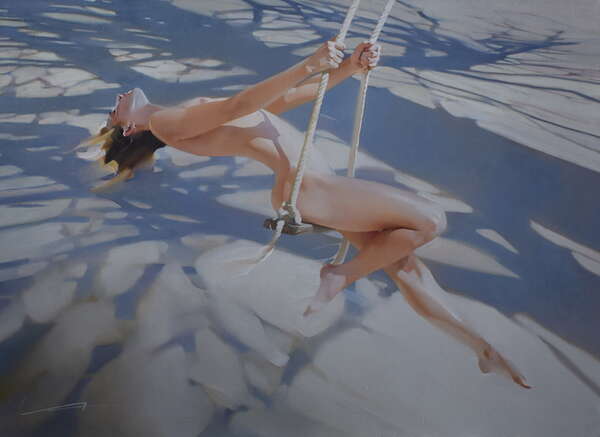
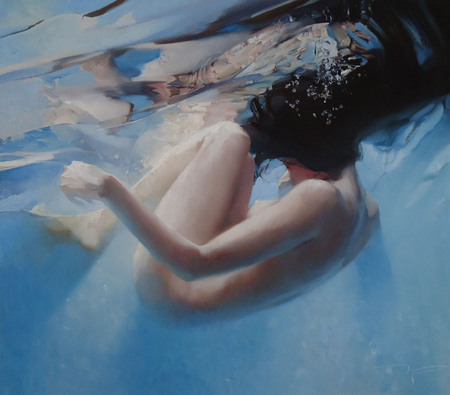
Alexey Chernigin. «Flying Away, ” 2024 / „Return, ” 2011.
Alexey Chernigov. «Return, ” 2019.
Through the prism of sincerity and sensuality, Alexey revives a sentimental utopia where elevated femininity, tenderness, and beauty are transformed into a universal language of harmony. His painting is an attempt to expand a moment into infinity, compelling the viewer to experience every detail as a revelation. This is the essence of his work: to remind us that eternity is hidden in the ability to see, feel, and value the fleeting—be it the tremor of light on canvas, the depth of a gaze, or the silence in which the pulse of one’s own heart can be heard.
Drawing Tenderness. Works by Sergey Marshennikov
Sergei Marshennikov. «Nude Reclining Figure, ” 2015.
Sergey Marshennikov is a contemporary Russian artist whose work has become a symbol of elevated femininity, where purity and eroticism merge into the harmonious image of a dream woman. Born in Ufa in 1971 to a family that encouraged his early interest in art, Marshennikov progressed from art studios to the Ufa College and the Repin Academy in St. Petersburg. His talent, recognized even during his postgraduate studies, attracted the attention of collectors from the United States and Europe, paving the way for international acclaim.
His creative output is a lyrical hyperrealism, in which art critics see a synthesis of the Russian painting tradition of the 19th century and the aesthetics of American artist Andrew Wyeth. Every detail in his canvases—from the interplay of light on skin to the folds of fabric—conveys not only realism but also a «living warmth» that envelops the viewer. The artist’s heroines, frozen in moments of serenity, embody modesty and chastity, while the subtle sexuality in their figures is utterly devoid of vulgarity. This is a tribute to the female essence as the quintessence of beauty, where languid poses, lace accents, and soft textures become metaphors for sensuality and the endless pleasure of beholding the beautiful.
As art critic Thomas Hall notes, even in works like «Pirate-Style Bed, ” Marshennikov avoids straightforwardness, transforming erotic subtext into the poetry of form. His paintings, imbued with captivating softness, evoke not merely admiration, but an almost physical sense of tranquility, as if time slows down, allowing one to contemplate an ideal that usually slips away in everyday life.

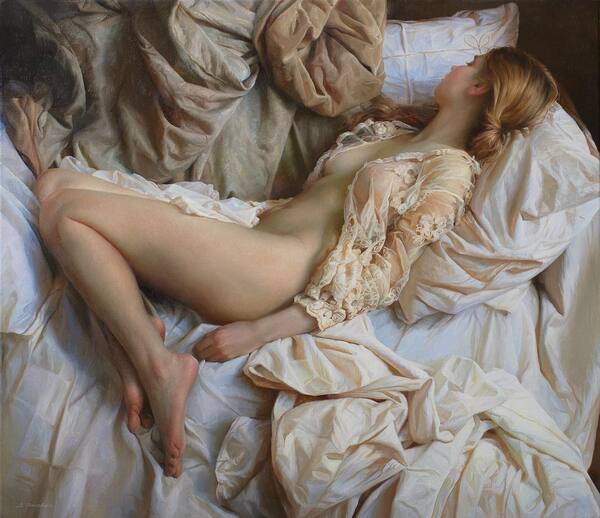
Sergei Marshennikov. «Model in a White Dress, ” 2013 / „Innocent Dream, ” 2013
Sergey Marshennikov revitalizes sentimental utopia, where the woman is presented not as an object, but as the embodiment of the sublime—a symbol of harmony between the corporeal and the spiritual. Through hyperrealism, saturated with subtle eroticism and lyricism, he transforms femininity into a universal language of beauty, purified of vice. His art reminds us that true beauty lies in the ability to see the eternal poetry of existence beyond a fleeting gesture, a play of light, or a fold of fabric, where the woman becomes a bridge between reality and the utopia of perfection.
2. Romanticism: Progress Over Comfort
Mikirtumov examines Romanticism as a unique worldview that forms in dialectical opposition to sentimental utopianism: while the latter (particularly in Rousseau) proposed streamlined models of morally perfect societies, Romanticism consciously rejects such systemic constructions, preferring instead fantastical insights and dystopian warnings.
As the author shows, the central aspect of Romanticism is its deep affective nature. The romantic perception of the world is shaped through intense emotional experiences in which irrational elements predominate: spontaneous emotional surges, the mystical apprehension of the absolute beginning through artistic creation, the contemplation of nature, or nostalgic recourse to a mythologized «golden age.» Such experiences, inherently resistant to rational articulation, find expression in a specific discourse where external images become tropes for conveying complex internal states.
This fundamental orientation toward subjective experience precludes Romanticism’s capacity to create coherent social utopias. Instead, within the Romantic sphere, genres of fantastic narration, parable, and fairy-tale allegory emerge—and what is particularly telling—critical dystopias. The dystopian mode is precisely the organic way for Romanticism to respond to modernity, especially its aspect of scientific and technological progress, which the Romantic consciousness perceives as a threat to authentic human existence.
As the author notes, the phenomenon of fantastic futurology (exemplified in the works of Ostrovsky, Verne, and Fedorov) only arises at a later stage of evolution, when Romanticism undergoes a process of social adaptation and ideological formation, where technological progress begins to be understood positively as a tool for expanding human capabilities. However, even in these later manifestations, a characteristic Romantic ambivalence persists: visions of the future inevitably balance between utopian hopes and dystopian anxieties, reflecting the era’s deep existential concerns.
A key takeaway is the thesis regarding the fundamental incompatibility of a Romantic worldview with the sentimental idea of a «cozy» existence.
If sentimentalism asserts the values of stable, self-contained well-being, the romantic ideal suggests continuous transcendence, often linked to the conscious rejection of mundane comfort in favor of higher spiritual values. Thus, romanticism, unlike sentimentalism, does not create finished social projects; rather, it develops a unique poetic language capable of expressing the existential crisis of modernity and outlining possible paths toward spiritual overcoming.
In the World of Simon Stelenhag
Simon Stelenhag. Series «Electric State, ” 2017.
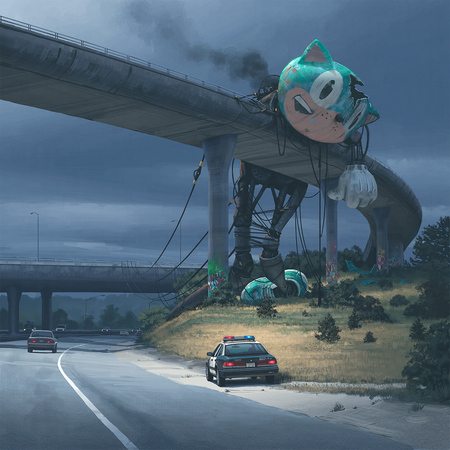
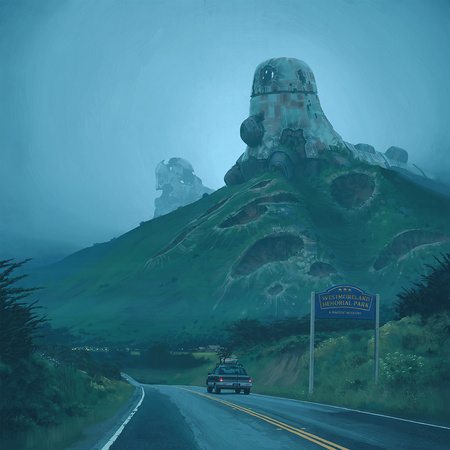
Simon Stelenhag. Series «Electric State, ” 2017.
Captivated from childhood by the stark beauty of Swedish landscapes, Simon Stelenhag began with landscape painting, following in the footsteps of his countrymen. Yet, over time, his work evolved, absorbing fantastic elements: on canvases that once featured pastoral idyll, robots, hadron colliders, and flying tractors began to appear. This alternate world, conceived by the artist, exists in a paradoxical unity of the everyday and technological phantasmagoria. The action takes place in late 1980s Sweden, where the government, having launched a massive underground scientific project with a nuclear accelerator in the 1950s, generated experimental technologies. Initially, everything went smoothly, but by the 1970s, the system began to crumble, spawning catastrophes. The people here continue to lead ordinary lives—going to work, watching television—but they are surrounded by the artifacts of collapse: rusted giant mechanisms, escaped dinosaurs from secret laboratories, and debris from incomprehensible machines.
Stelenhag, inspired by sci-fi writers such as C.S. Lewis, created a world where vintage automobiles coexist with technologies whose purpose remains enigmatic. His paintings—blending nostalgia for childhood with the grim romance of scientific progress—have become a visual chronicle of a quiet apocalypse. The causes of the disaster are unclear: perhaps experiments spiraled out of control, perhaps aliens or corporations intervened. But the result is evident—a civilization frozen in a state of aftermath, where people struggle to survive amid the consequences of their own ambitions.
Stalhenberg’s creativity reflects the paradox of contemporary art: by romanticizing scientific progress, it inevitably trends toward dystopia. His world is a metaphor for the duality of technologies that, while promising prosperity, carry threats. The artist demonstrates how blind faith in science transforms idyll into ruins, where the mundane coexists alongside an apocalypse that happened «yesterday.» This serves as a warning about the fragility of human ambition—where even the most beautiful dreams can turn into a silent collapse disguised as everyday life.