concept
Representing abstract concepts has always been one of art’s most challenging tasks. Phenomena such as love, fear, virtue, or sin cannot be perceived directly. However, during the Renaissance, the concept of sin acquired a visible form and recognizable contours—for instance, through human actions, symbolic objects, allegorical figures, or depictions of sin’s consequences. The focus of this study is how moral concepts are conveyed through visual imagery and become comprehensible to the viewer.
The Northern Renaissance is particularly significant when viewed in the context of this theme. Art of this period is characterized by the use of symbols, fantastic creatures, grotesque imagery, and religious narratives. Moreover, the masters of that era paid great attention to detail, enabling even the most ordinary, seemingly trivial objects to acquire deeper meaning. This approach allowed complex ideas to be communicated not only through the overall narrative of the canvas but also through individual fragments of the painting.
Objective
— to identify the visual means through which Northern Renaissance artists rendered sin visible.Tasks:
to select works by various artists; to group them according to the method of visualization; to analyze how specific details, poses, scale, and composition convey a moral category; to compare the solutions of different artists; and to draw a general conclusion.Object
— the painting and graphic arts of the Northern Renaissance, 15th–16th centuries.Subject
— the visual techniques that transform sin, vice, temptation, and punishment into visible imagery.Main Question:
What visual means did Northern Renaissance artists use to make the invisible concept of sin visible?Hypothesis:
Sin was depicted not only through direct religious subjects but also through a system of visual metaphors—symbolic objects, animals, fantastic creatures, human actions, and bodily forms—which the viewer recognized as a «language.»When selecting the artworks, consideration was given to their belonging to the art of the Northern Renaissance (the Netherlands and Germany, approximately 1440–1570), as well as the presence of imagery related to sin, vice, temptation, the fall from grace, punishment, and moral choice. It was important to cover various methods of depicting these concepts—from individual details and symbolic objects to entire, complex scenes. Therefore, the study includes works by different artists and in various formats, including painting, triptychs, and engravings.
The research is divided into three chapters, each demonstrating different ways of depicting sin. The first chapter presents sin through allegory, symbol, and daily behavior. The works examined for this chapter reveal vice through objects, animals, isolated actions, or everyday situations. The second chapter is dedicated to the depiction of temptation, human desire, the moment of choice, and the violation of moral norms. The third chapter explores images of hell, the Last Judgment, punishment, and reminders of human mortality.
This division helps trace how the depiction of sin evolves—from its designation through symbols and actions to its commission and consequences. However, this segmentation is conditional, as a single artwork may simultaneously address several themes and present different facets of sin.
«The Carrying of the Cross» — Hieronymus Bosch; 1510–1535
Navigation 1. Allegory and Symbols 2. Temptation and the Fall 3. Punishment
Allegory, Symbols, and the Everyday
Chapter one examines paintings in which the idea of sin is revealed through actions, symbolic objects, and allegorical figures. Special attention is paid to how these elements help convey the concept embedded within the work.
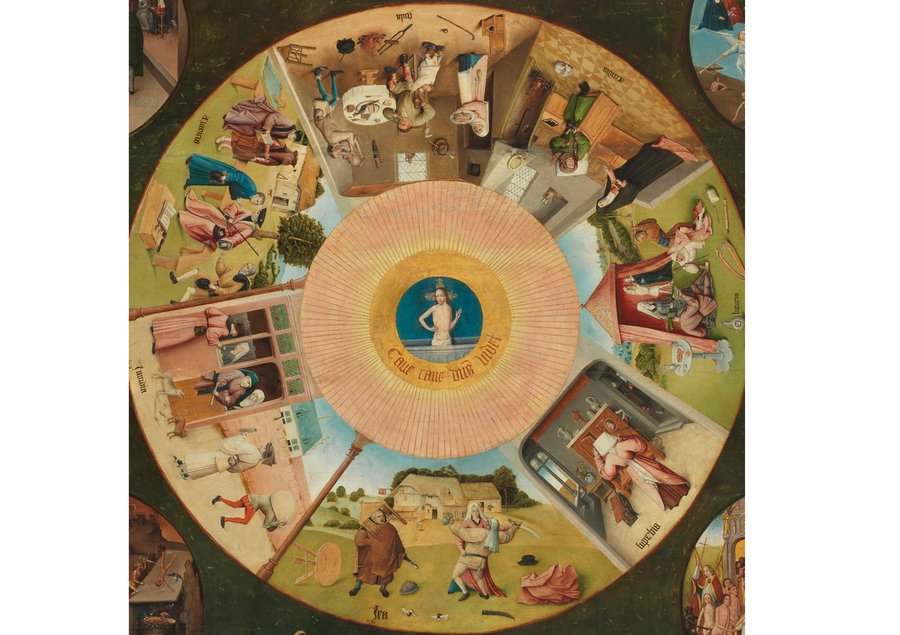
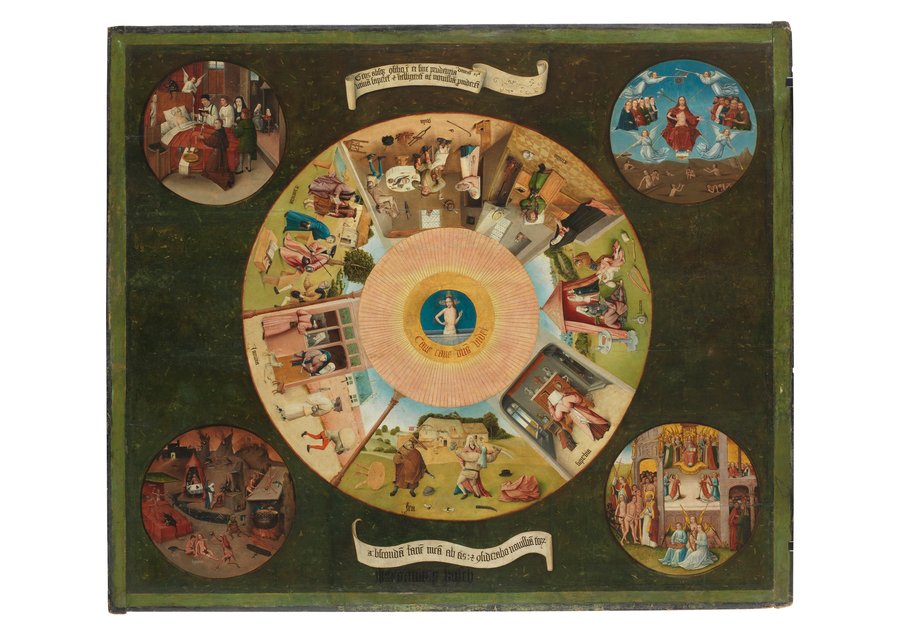
«The Seven Deadly Sins» — Hieronymus Bosch; attribution is disputed. 1505–1510
In Hieronymus Bosch’s «The Garden of Earthly Delights,» sin is illustrated through mundane situations, such as: fighting, bribery, gluttony, and vanity. While individual fragments depict a specific manifestation of sin through actions, the overall composition conveys to the viewer the danger of sin and the responsibility for one’s deeds. Christ is positioned at the center of the circle, acting as an all-seeing eye surrounded by scenes of human behavior, and an inscription warns that the Lord watches over what is happening. Furthermore, four images are arranged around the edges of the painting: sin, judgment, hell, and the Kingdom of God.
«The Hay Wain, ” central panel of the triptych — Hieronymus Bosch. 1512–1515
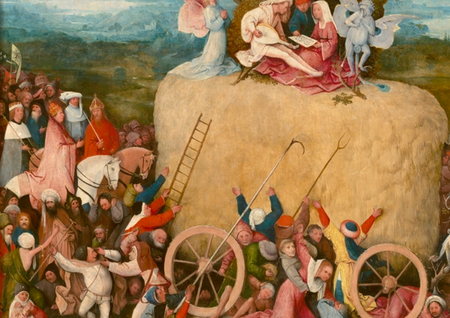
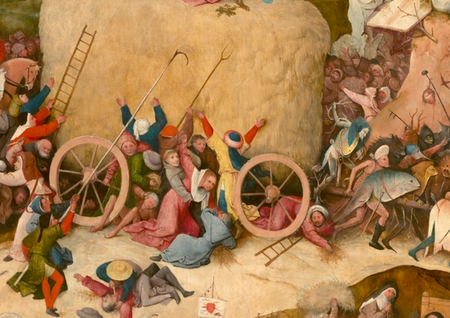
«The Hay Wain, ” central panel of a triptych — Hieronymus Bosch. 1512–1515
At the center of the triptych lies a massive haystack, around which a struggle erupts among people vying to claim even a small portion of the hay. On the painting, this haystack functions as a metaphor for transient worldly goods. Moral decay is visible not only in isolated fragments of violence and greed but also in the overall composition: humanity’s pursuit of earthly possessions unites different social strata, rendering them equal in their sin. The direction of movement in the painting also carries meaning—the procession is aimed toward hell, depicted on the right side of the triptych. Unlike in «The Table of the Seven Deadly Sins,» where vices are shown in discrete domestic vignettes, in «The Haystack,» Bosch portrays a generalized image of humanity striving for earthly pleasures while forgetting morality (evidenced by the fact that no one looks upward toward the image of God). The sin depicted here is not a specific act, but rather a collective delusion leading to ruin.
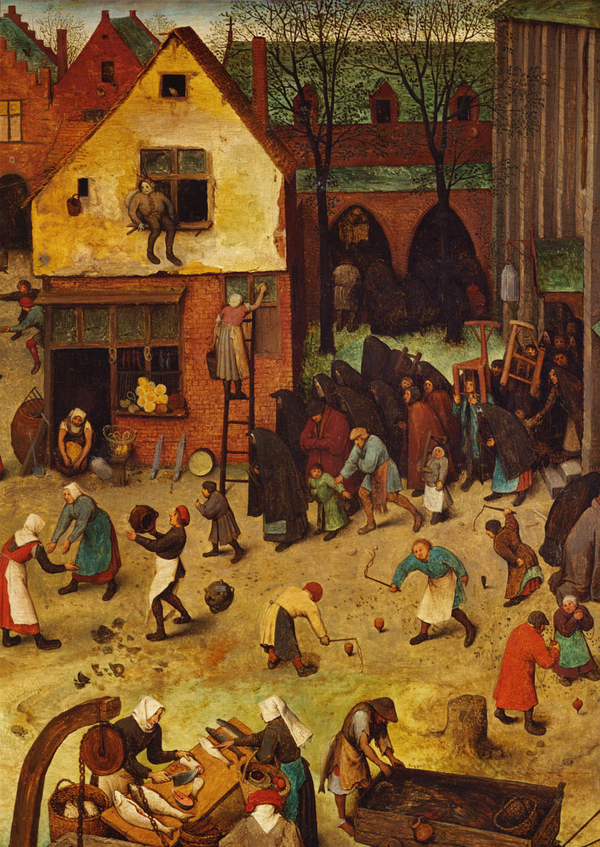
«Maslenitsa vs. Lent» — Pieter Bruegel the Elder. 1559
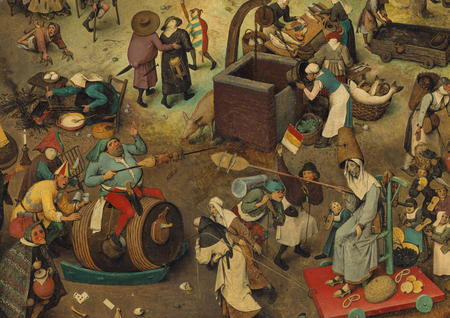
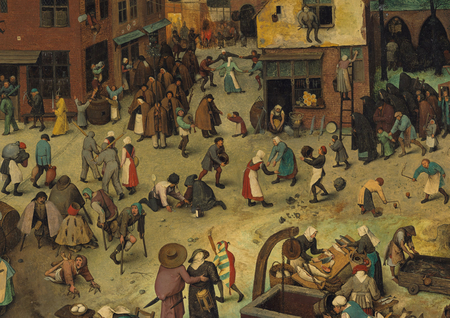
«The Battle of Maslenitsa and Lent» — Pieter Bruegel the Elder. 1559
In the painting «The Battle of Maslenitsa and Lent"—the main part of the composition is in the foreground: two figures. On the left is Maslenitsa—a stout man standing on a barrel, holding a meat spit. His opponent is Lent—a thin figure carrying a shovel on which rest two fish. Their poses and movement toward each other resemble a tournament duel. Through the body types, objects, and actions of the characters, abundance and abstinence are given human form. This is where the allegory manifests: abstract concepts are presented as active figures.
The confrontation also continues in the surrounding scene, which depicts both entertainment, the abundance of food and drink, and religious and fast customs. The painting cannot be clearly divided into a side of sin and a side of virtue; Bruegel unites different forms of behavior in one place, inviting the viewer to compare them independently.
For study, the painting is significant as an example of how allegorical opposition connects with everyday scenes: moral distinctions become visible through bodies and objects, yet they are not reduced to the unambiguous condemnation of one side.
«Pride» by Pieter van der Heyden, after a drawing by Pieter Bruegel
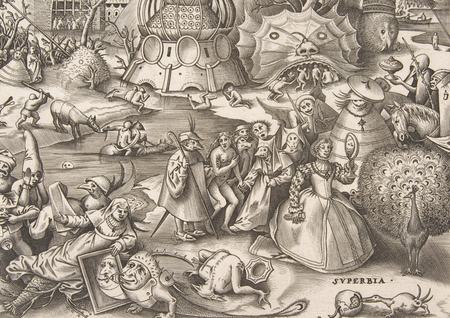
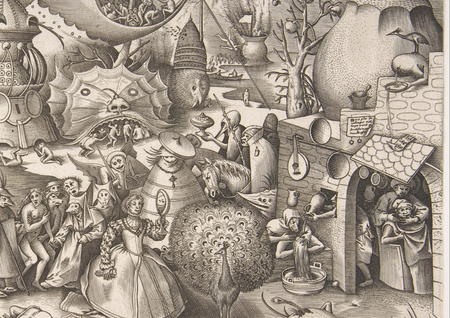
«Pride» by Pieter van der Heyden after a drawing by Pieter Bruegel
The engraving is part of the series «Seven Deadly Sins.» At the center is a female figure personifying pride. Here, the sin is portrayed not only through a specific action but also through personification: the sin takes on a physical form—specifically, a human appearance. Surrounding her are fantastical creatures and unusual scenes that extend the theme of vice beyond the central image. This combination of allegory and grotesque is connected to Bruegel’s engagement with Bosch’s artistic language.The overall setting of the painting allows for the examination of pride as a phenomenon that manifests in various forms and actions. Thus, vice is not indicated by a single detail but becomes the foundation of the entire depicted world.
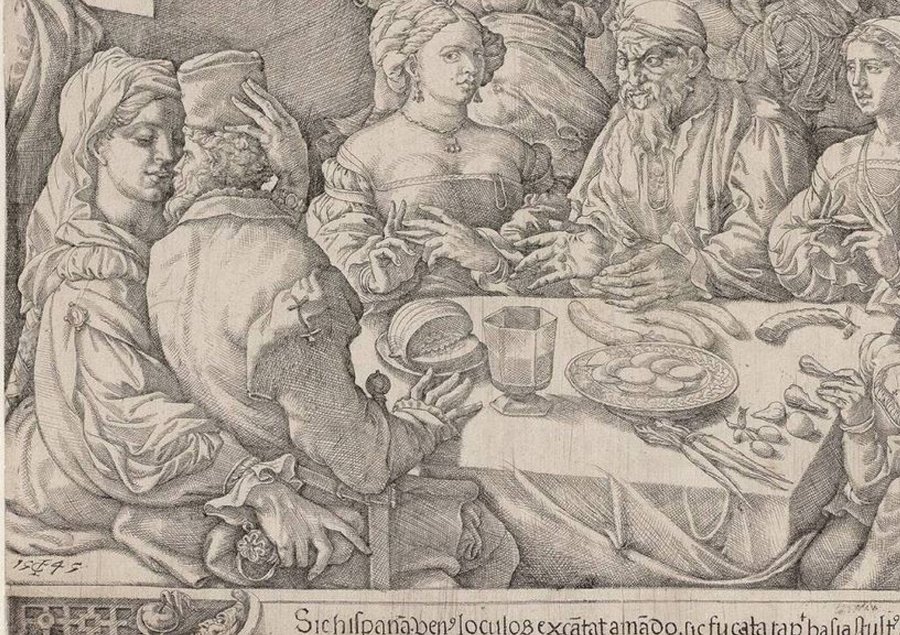
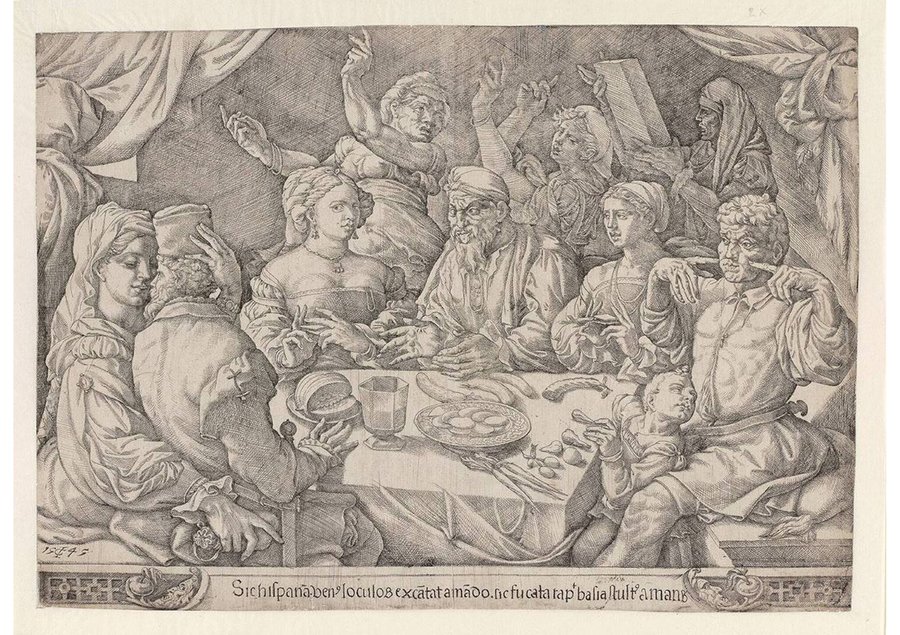
«Spanish Brothel» — Jan Cornelis Vermeyen. 1545.
The engraving depicts a group of men and women gathered around a table. Sensual interaction, food, and entertainment form a space of pleasures. Moreover, the behavior of the people shown reveals that beneath the outward merriment lies debauchery and self-interest: on the left, a woman embraces a man while simultaneously reaching for his wallet. For visual analysis, the duality of the gesture is crucial. The embrace appears as intimacy, but the action involving the wallet alters its meaning. Vice is exposed through the mismatch between the outward expression of affection and the hidden intent. The work allows us to view sin not as an abstract category, but as a relationship between people where pleasure merges with deceit and avarice.
«The Ship of Fools» — Hieronymus Bosch. 1491
The painting depicts a boat filled with people engaged in eating, drinking, and recreation. Clergy are also part of this company, participating in the descent into sin. Art critics link this scene to gluttony and a lack of moral guidance, noting that the ship is stuck in the shallows and making no progress. The moral meaning arises from the contrast between their lively activities and the absence of meaningful direction. The people are united by base and simple pleasures, but not by a common goal.
Sin becomes visible through composition, symbolic imagery, and everyday behavior. In all the analyzed works, the flaw is shown not only through individual objects but also through character actions and compositional structure.
Temptation and the Fall
In this chapter, sin is examined as a process: from temptation and the possibility of choice to the act itself and its consequences. Through gestures, character interactions, and changes in the surrounding world, the artist illustrates how a person succumbs to temptation or resists it.
«Adam and Eve» by Albrecht Dürer. 1504 «Adam and Eve» by Jan Gossart. 1510
Dürer depicts idealized human bodies set within a meticulously rendered natural environment. Tension emerges through the figures' gestures and their interaction with the forbidden fruit. The viewer witnesses the moment when existing harmony is under threat of disruption. The fauna in the engraving further aids in developing the theme. The animals in the image—a cat, a rabbit, a bull, and a moose—traditionally symbolized the four temperaments that existed in balance before the Fall.
Sin in the engraving is revealed through the contrast between external harmony and the action that leads to its violation. Dürer creates an image of order, the loss of which is only hinted at through the forbidden fruit and the characters' gestures. The moral significance arises from the tension between the world’s harmonious state and the possibility of its destruction.
Next, it is interesting to examine Yan Gossard’s painting, «Adam and Eve.» The artist compositionally refers to Dürer’s namesake engraving but changes the nature of the work. The artist retains the proportions, but the faces become more individual; instead of a forest, it is more like a woodland edge with animals.
However, where Eve in Dürer’s work is only reaching out toward the fruit, in Gossard’s piece, she has already plucked the forbidden fruit. Adam is pointing to the branch, the fruits, and the leaves, which have already begun to wither. Sin in this work finds visual expression through the changes in the tree. One could say that the consequences of sin begin to show themselves even before expulsion from paradise.
«Adam and Eve» by Lucas Cranach the Elder. 1526.