Table of Contents
- History of Creation
- Revitalization of Folk Crafts
- Petro’s Cold Creation
- Misty Albion
- Satire in Faces
- The Master and His Creation
- Conclusion
- Bibliography
History of Creation
The history of the animated film «The Left-Hander» began long before it appeared on screen. As early as the mid-1930s, the young artist Ivan Ivanov-Vano conceived of adapting Nikolai Leskov’s fairy tale into an animated language. This was not limited to a single idea: along with his sisters, the Brumbergs, and the artist Vadim Lazursky, the director began developing the script and preparing the initial sketches. The artists studied historical materials in libraries and museums, gradually forming the visual concept for the future film. However, it took nearly three decades from the initial idea to its realization—the film was only released in 1964, by which time Ivanov-Vano had become one of the masters of Soviet animation. Although the script was accepted for production after numerous revisions, filming never began. As Lazursky later recalled, economic difficulties and the constant postponement of work led to the project being shelved [1, p. 59].
In his own memoirs, the director admitted that he was primarily drawn to the opportunity to tell the «tragic story of a Russian prodigy» [2, p. 220]. Hidden within the outwardly unassuming plot about a Tula craftsman who managed to shoe an English flea was a story of talent that was simultaneously a source of national pride and a victim of public indifference. Ivanov-Vano sought to preserve the engaging quality of Leskov’s narrative in his film adaptation, blending irony with admiration for folk craftsmanship and sorrow for the fate of an ordinary person [2, p. 221].
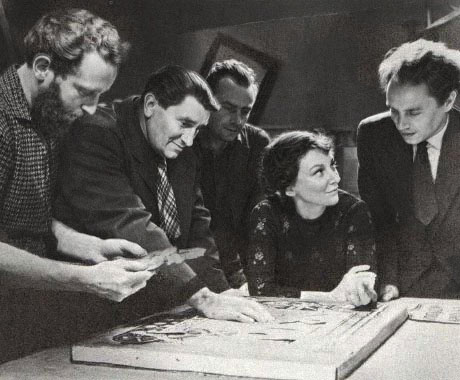
Yuri Norshteyn, Ivan Ivanov-Vano, Anatoly Kuritsyn, Marina Sokolova, Arkady Tyurin during the production of the film «The Left-Handed, ” 1964.
Interestingly, Ivanov-Vano calls «The Left-Hander» one of his favorite cartoons [2, p. 220].
By the early 1960s, new artistic conditions had emerged to realize this vision. Soviet animation was moving away from illustrative styles, increasingly turning to the possibilities of stylized drawing, caricature, book graphics, and decorative art [3]. The perception of the audience was also changing: animation was more confidently tackling complex literary plots intended not just for a young audience. For Ivanov-Vano, who had already frequently referenced Russian folklore and literature, «The Left-Handed Bear» offered an opportunity to continue the search for a national artistic language—this time, outside of the familiar fairytale aesthetic.To work on the film, the director engaged young artists Arkady Tyurin, Anatoly Kuritsyn, and Marina Sokolova. The creation of its visual identity was preceded by extensive preparatory work: they studied folk craft, antique graphics, wooden architecture, carving, and decorative painting [2, p. 222; 4]. The creators perhaps did not aim for exact replication, but they closely approached the subject matter to demonstrate how the era itself could tell its story through its characteristic artistic forms.
As a result, three main pictorial directions were developed. The scenes from Tula, related to the lives of ordinary citizens and festive celebrations, were rendered in the aesthetics of Russian lubok, with its vibrant colors and expressive decorative style. Imperial palaces looked completely different: their interiors were based on old engravings and were meant to convey the cold solemnity of court life. Attach card
Finally, England. The journey to this country received a different graphic treatment, inspired by the English engraving tradition. Thus, the artists conceived a unique visual representation for each space [2, pp. 223–224].
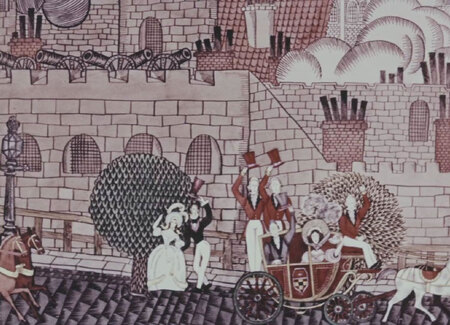
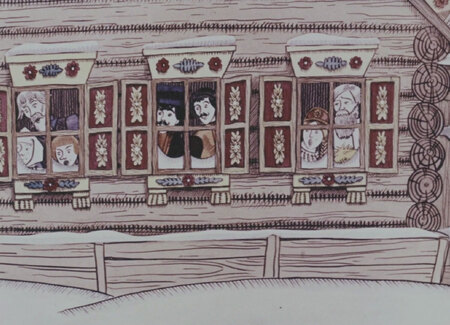
London and Tula in «Levshe.»
The animation utilized cut-out animation. Instead of the familiar sequential drawing of movements, characters were created as flat paper figures whose individual parts moved in front of the camera. In a way, «The Left-Hander» is reminiscent of a living illustrated book for the viewer. It is interesting that this stylistic choice helped emphasize the grotesque nature of Leskov’s narrative.
Subsequently, researchers evaluated the stylistic unity achieved by the creators in varying ways. Film scholar Sergei Asenin viewed «The Left-Hander» as a cohesive work that successfully unified diverse representational traditions [3]. Lev Anninsky, on the other hand, focused primarily on the restrained graphic style of the film. According to his observation, the subtle engraving quality of the imagery defined the overall character of the animated film—a quality noticeably different from the lush, expressive imagery of the theatrical productions of «The Left-Hander» [5, p. 149].
In August 1964, «The Lefty» premiered on Soviet screens. That same year, the film received an honorary diploma at the VII International Festival of Short and Documentary Films in Leipzig. Among the animators who worked on the film was the young Yuri Norstein, who would later become one of the most prominent figures in Soviet auteur animation.
Revitalizing Traditional Crafts
The opening credits for «Levshi» introduce the viewer to the artistic diversity of a world where folk decorative arts form the foundation of the cinematic language. The illustrations in the credits recall motifs from Mesенский and Boretsky painting, folk embroidery patterns, narrative wooden painting akin to Gorodtsy style, lubok prints, and Zhostovo painting.
The transition from decorative title sequences to the main action of the film becomes particularly compelling. If folk art exists primarily as ornament confined within a rectangular frame in the opening credits, its expressive techniques subsequently transcend the arbitrary painted surface and begin to shape the space itself. Lubok illustrations, patterns, and graphic elements migrate into landscapes and urban environments, becoming reflected on the characters.
In my view, this principle is most consistently manifested in the Tula episodes. As Ivanov-Vano recalled, the scenes related to Tula were specifically conceived in the style of Russian lubok. The director explained his choice of this artistic tradition as an attempt to convey the festive atmosphere and the emotional elation of simple life [2, p. 220]. There is a discernible pattern in this decision.
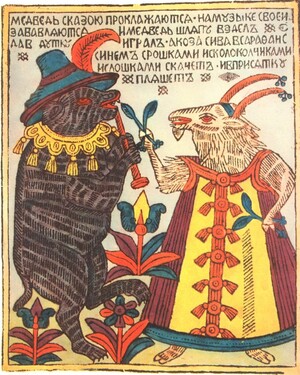
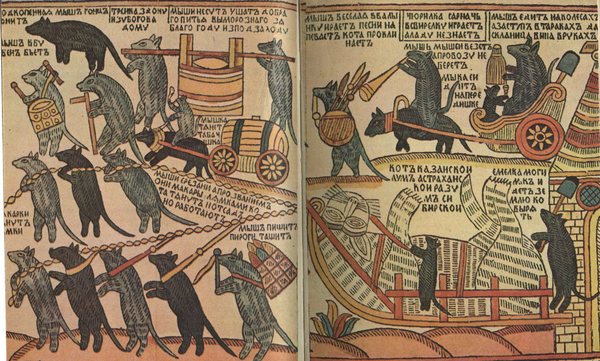
Lubbok prints «Bear and Goat Cooling Off» (18th Century) and «How Mice Buried the Cat» (18th Century). Unknown artists.
It is relevant here to refer to Yuri Lotman’s study, «The Artistic Nature of Russian Folk Pictures.» Lotman viewed lubok as a specific artistic system where the image is closely intertwined with language, action, and visual perception. According to his observations, the folk picture possesses a unique narrative quality: a static image is capable of encompassing several sequential events unfolding over time [6].
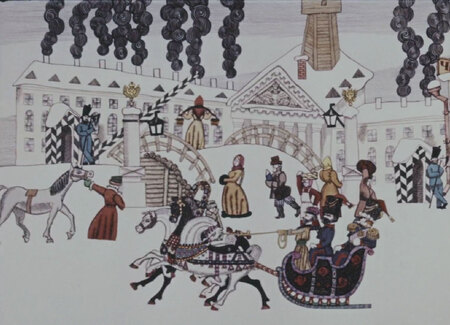
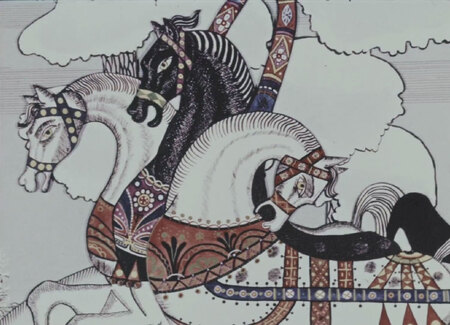
In this regard, the filmmakers' reference to the popular print style acquires an added layer of meaning. The animation essentially actualizes the inherent potential for movement within the craft, allowing the images not only to depict the story statically but also to enact it dynamically.
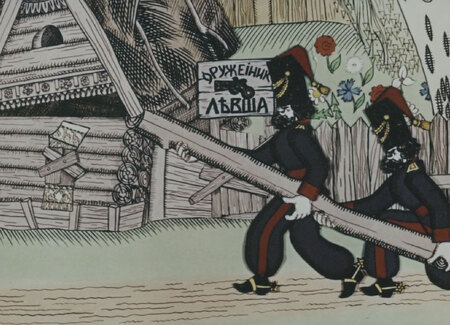
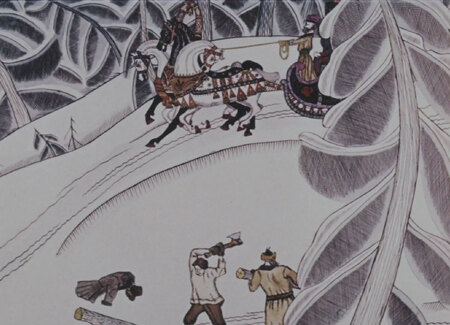
However, the artistic world of «Levsha» is shaped by more than just lubok prints. The tradition of decorative wood painting I mentioned above, noticeable in the introductory title sequences, depicts images of horses, birds, people, and fantastical plants—motifs reminiscent of everyday life objects like spinning wheels, barrels, and boards. It is telling that these images were originally found on objects of completely mundane domestic use. A spinning wheel, a box, or other household implements became simultaneously a useful item and a work of art.
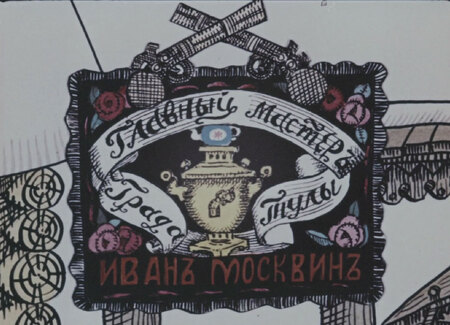
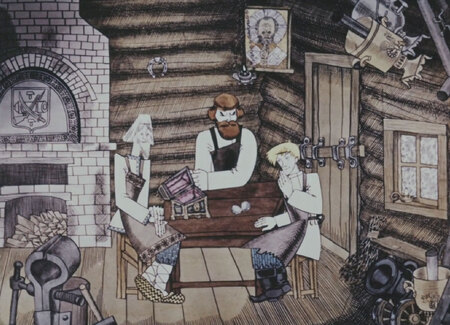
The first frame strikes me as a harmonious eclecticism—it features flowers from Zhostovo trays, paper drapery reminiscent of Peter the Great’s engravings, and the bottom text «Ivan Moskvin» seems to reference popular storybook typography as well. The second frame, conversely, is also adorned with folk crafts, creating a domestic atmosphere.
At «Levesh,» this function undergoes a unique transformation—the ornament is liberated from its material carrier and becomes part of the cinematic image. Furthermore, the rejection of the illusion of three-dimensional space is, in my opinion, a consistent artistic decision.
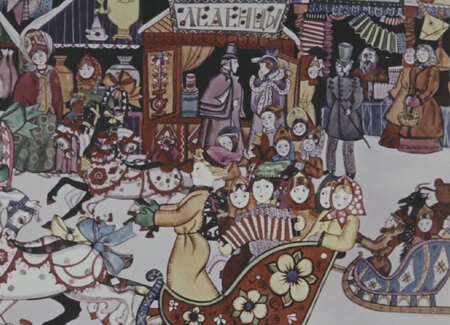
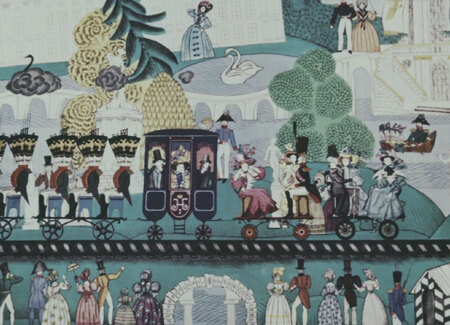
The cartoon in the general scenes resembles a collage—many objects are present, and the conventional laws of aerial perspective are almost absent. Although the image appears flat, its layered flatness lends it expressive quality, reminiscent of early cinema, where scenes were also rich with a multitude of small details one could examine for extended periods.
However, what is perhaps most interesting is the filmmakers' reference to the paintings of Boris Kustodiev and the graphics of Ivan Bilibin [2, p. 13]. In the works of these masters, the expressive quality of original traditional scenes from folklore and daily life is clearly evident. In Kustodiev’s paintings, the festive life of a Russian city appears as a colorful spectacle—dynamic, filled with fairground bustle and a variety of human figures. And in Bilibin’s illustrations, one finds the flatness and expressiveness inherent in animation.
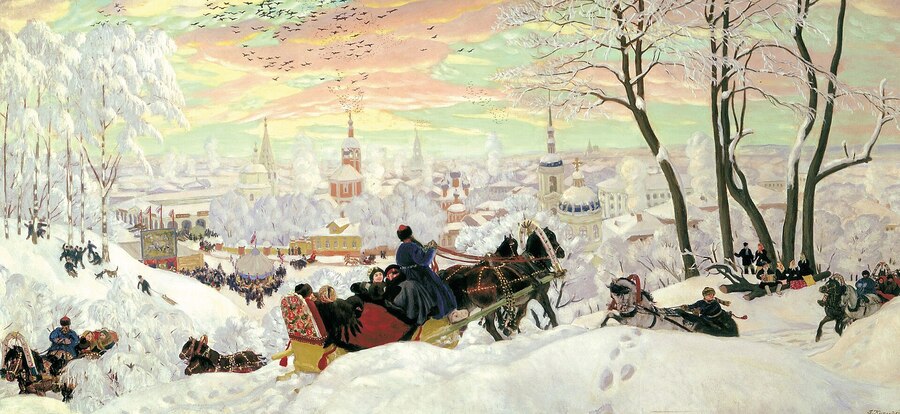
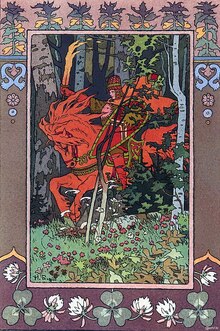
On the left: Boris Kustodiev, «Fair» (1916). On the right: Ivan Bilibin, «Vasilisa the Beautiful» (1900–1902).
Addressing Kustodiev reveals another significant characteristic of the artistic solution in «The Left-Hander.» The animation draws not only on direct examples of folk art but also on the tradition of its subsequent reinterpretation in the visual arts. In other words, the artists engage with Russian culture on multiple levels: through ornament, through lithographic graphics, and through the painted image of old Russia that developed in the art of the early 20th century. All of these elements coalesce into a single, integrated system.
Before the viewer, a composite image of the past forms—a mosaic constructed from various recognizable artistic motifs. History coexists with fantasy, decoration with narrative, and folk crafts with professional painting and graphics.
Cold Peter’s creations