Concept
Solitaire is a single-player card game involving the sorting of objects in a certain way. It is an accessible way to pass the time because it requires minimal equipment: one or two decks of cards, or a program on a computer or phone. Solitaire can be an entertainment during a long trip or a distraction from troubling thoughts. Many Solitaire games are excellent puzzles, and solving them brings great pleasure. Because of its unique features, this game can help manage emotions, and it is useful in various situations due to its versatility.
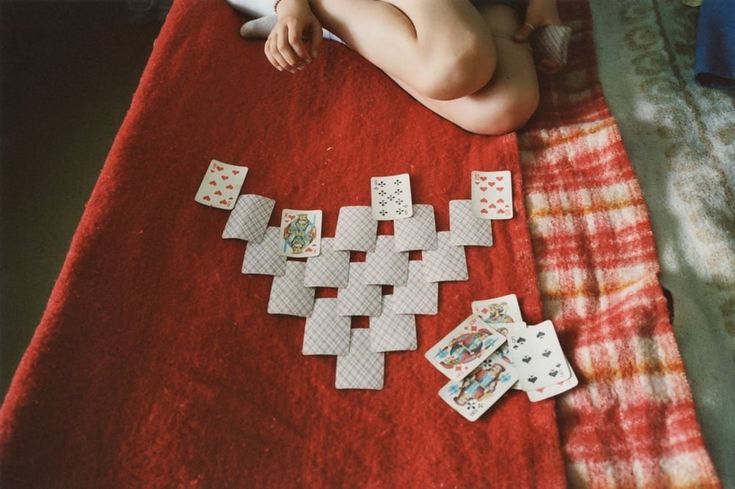
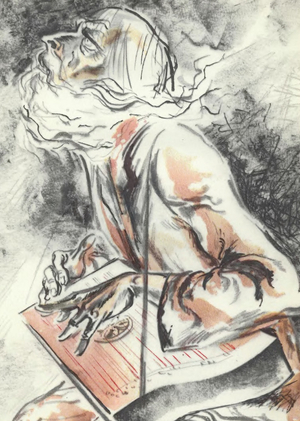
Claude Dorri—photo from the Artek series, 1994–2003
The exact origin of solitaire (from French Patience—patience) remains a subject of debate. The earliest published collection of solitaire was recorded in a German anthology of games in 1783. The English historian and board game researcher David Parlett believes that solitaire was originally a two-player game, with each player using a separate deck [1]. Its popularity rose in France in the early 19th century, and it was then that some of the still-known card games were invented [2].


Benson Frank Weston — Girl Playing Solitaire, 1909
Historians attribute a fondness for solitaire to many famous figures. For instance, there is a legend that Napoleon passed the days on Saint Helena Island playing this game [2].
Winston Churchill is said to have been passionate about more complex variants of solitaire involving two decks. Former U.S. Secretary of Defense Donald Rumsfeld shared a version of the game, which he claims Churchill invented and played during World War II—a game that demands special skill, focus, and the ability to perceive a winning strategy [3].
Leo Tolstoy also mentioned solitaire. In his book «Childhood, ” he describes the main character’s grandmother as using the game to distract herself from a bad mood [4].
«Grandma was sitting sideways, laying out the ‘Traveler’ solitaire game, which always signaled a very ill disposition.»
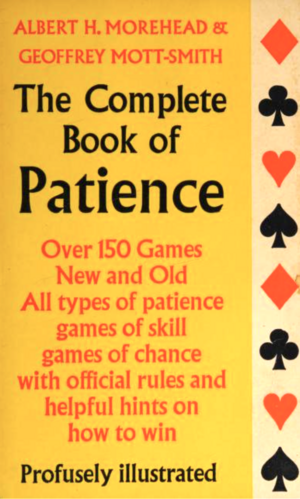
Based on a deck of cards, an infinite number of different games could be invented. The large collection of patience games, «The Complete Book of Patience,» was first published in 1950. Albert Morhead and Geoffrey Mott-Smith documented over 150 variations of patience, consolidating numerous game options using one, two, or four decks into a single book [5].
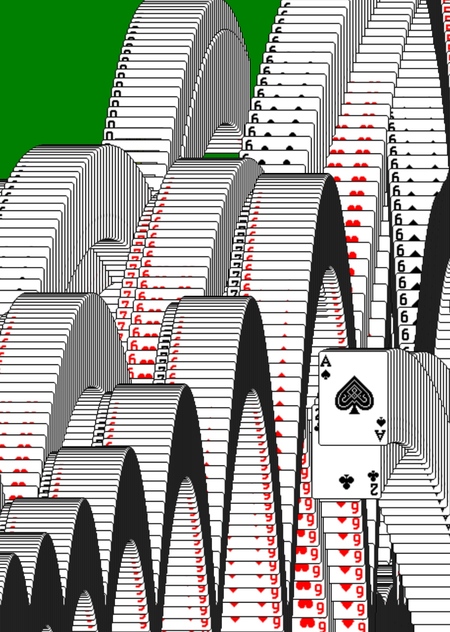
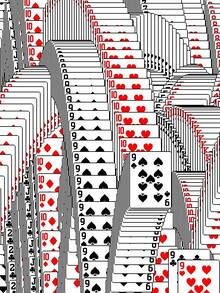
Solitaire was adapted for the Windows 3.0 system in 1990. Klondike (Косынка), FreeCell, and Spider are the most famous solitaire variants because, through these card games, users learned how to control the mouse. [6] Today, people who do not have a physical deck of cards can play classic and new variations on their devices, and many were first introduced to the game of solitaire thanks to computers.
The Strong Museum — Solitaire on Windows 3.0
In this study, I will examine solitaire as a solitary game that can be used as a self-regulation practice—different variations can help manage various psychological states. By playing, a person can calm down, reboot, or lift their mood with a small, pleasant victory. Solitaire is an ideal game for such a pause due to its versatility and accessibility.Sections:1. Features of Solitary Games2. Solitaire Mechanics3. Self-Help Through Play4. Conclusion5. Sources
1. Features of Solo Games
There are numerous reasons for playing solo. The choice of this form of leisure can stem not only from the absence of other players nearby or online, but also from the unique mechanics, the feeling during individual playthroughs, or the tactile sensations derived from analog gaming items [8]. Playing solo also creates a protected space where an individual is free to regulate time, duration, interaction rules, and the degree of involvement in the activity.
«To be autonomous means to act with a sense of free will, willingness, and internal consent; it means fully approving and accepting the behavior you are engaging in» [7].
Autonomy is a fundamental need that sustains intrinsic motivation. The spectrum of human motivation ranges from purely internal to completely controlled external motivation. In the latter case, an activity is driven by outcomes separate from the activity itself, such as rewards or punishments. Controlled motives are experienced as unpleasant, effortful, and strained by a sense of «I must» [7]. In group games, there are situations where one or more participants no longer wish to continue but play in order not to upset others, avoid in-game penalties, and complete the previously scheduled session. Results from Dale Leora’s survey (2018) showed that a particularly strong factor in people choosing to play alone is the ability to not wait for or conform to other players [8].
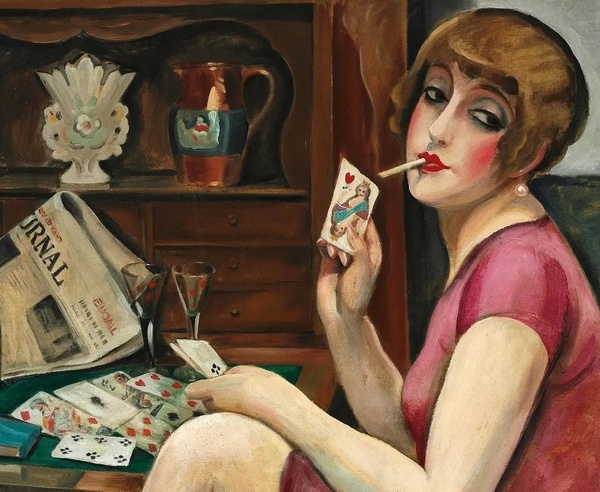
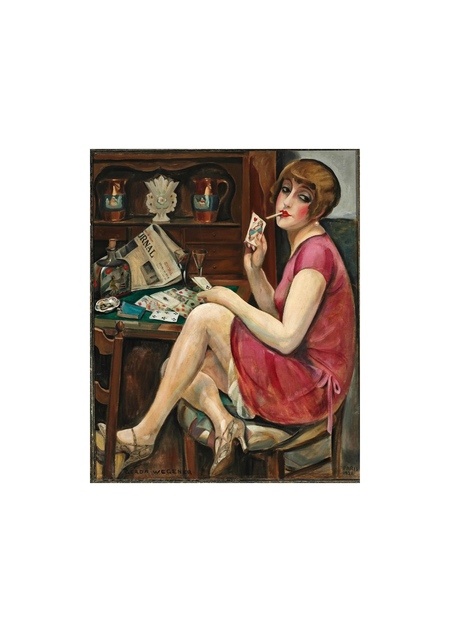
Gerda Wegener—Patience, early 20th century
In a study of feelings of autonomy conducted among reviewers, testers, and other individuals whose professional work involves games, a specific perceptual tendency was noted: «They referred to a game motivated by internal interest and a sense of autonomy as a ‘game, ’ while a game influenced by controlled motives, lacking internal motivation, they labeled as ‘work’ or ‘something like work.’» Respondents indicated that the autonomy to decide whether and when to play directly affected their satisfaction with the activity: «One participant started playing when they felt, ‘I want to play on the computer right now, and nothing is stopping me—I don’t want to do anything else; so I just do it and launch the game.’ The players would continue [playing] and stop when they ‘simply lost interest again’» [7]
The intrinsically motivated decision to spend time playing a game brings satisfaction in itself—provided the game is interesting, varied, and requires no convincing or waiting for others to join. Solitaire does not require a second player; a person can play whenever they wish, stop at will, and control the difficulty by selecting a different layout option.
Icar Louis France — Solitaire. 1926
Solitaire possesses all the merits inherent in single-player games. However, its specific characteristics—cyclicality, moderate unpredictability, and orderliness—suggest that the gameplay may positively affect the player’s psychological state. In the following section, I will discuss the rules of several variants across different types.
2. Solitaire Mechanics
Solitaire — a group of diverse games that employ gameplay mechanics such as pattern matching, sorting, unlocking, scoring, repetition, and element movement.
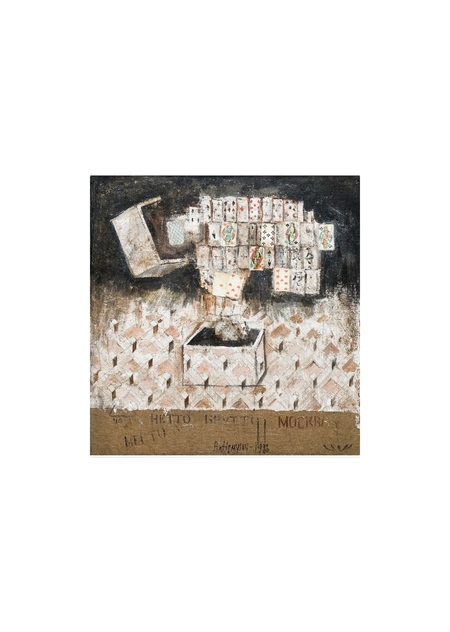
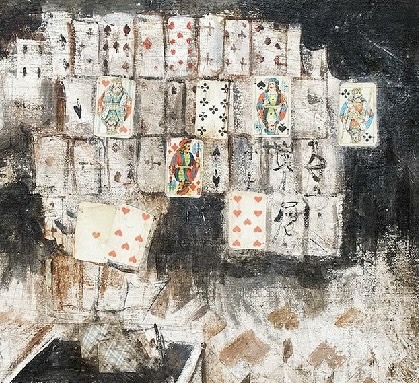
Nemukhin V.N.—Evening Solitaire, 1988.
The Solitaire game is based on sequentially laying cards on the table with the goal of moving them to the foundation piles. The objective of the game is to arrange the cards of each suit in a specific order, for example, from Ace to King. Unused cards from the deck are turned over and built into columns or rows of cards on the playing field. To find the necessary cards, you must arrange the deck by value, suit, or color.
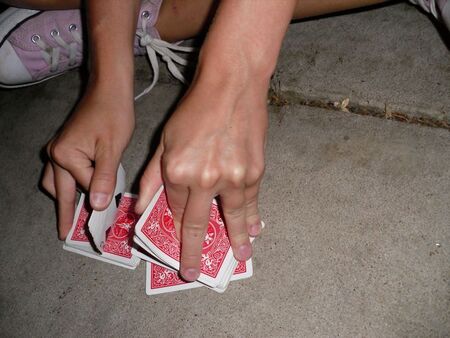
Simple and complex solitaire games are distinguished.Simple ones are quickly laid out, sometimes in less than five minutes. Such games most often have a solution. Examples include Klondike and FreeCell.Complex solitaire games require specific skills or patience. Sometimes the game does not presume a solution—you must start over or use the Mercy technique. Among complex games are Spider, Yukon, and Scorpion [9].
Mercy Taking — permissible «cheating» within the game. It can involve moving a blocking card or other actions that help advance in the game. Sometimes the rule allows transferring any open card to another pile, disregarding suit or rank, if no other moves are available. Re-takes are also part of Mercy Taking.
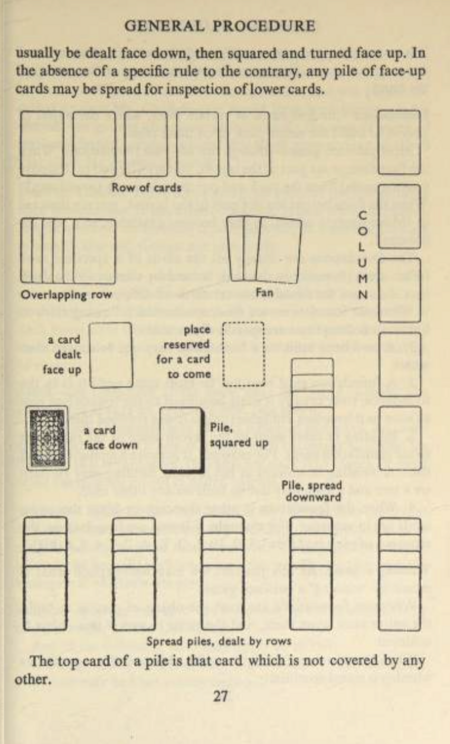
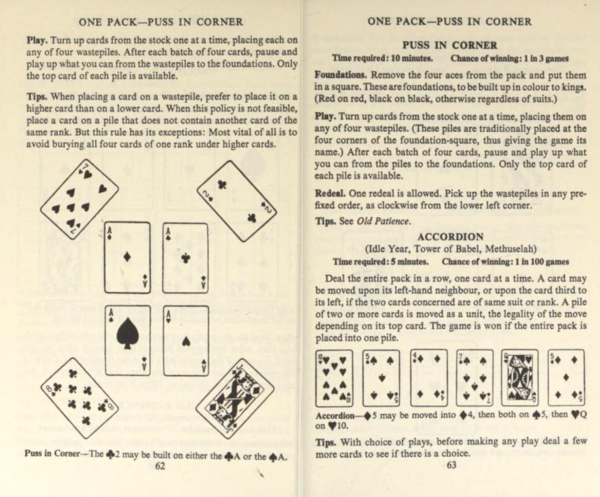
Some terms that will be useful when discussing the rules of the games:Layout, tableau (Eng. and Fr. tableau) — the main part of the patience layout; that is, the entire layout excluding the hand, the discard pile, the reserve, and the foundations. In most patience games, the layout consists of columns onto which cards can be collected in a specified order.Nominal value, or rank (Eng. rank, value) — the number corresponding to the card. Ace corresponds to 1, Jack to 11, Queen to 12, and King to 13. Numbered cards correspond to the number marked on them (from 2 to 10).Foundation (Eng. and Fr. foundation) — the place where cards must be collected. The patience game is considered won if all cards are placed in the foundation piles [10].Next, I will talk about the mechanics of patience that allow the games to be so diverse.< Page from the book «The complete book of patience»
Searching for combinations
In Monte Carlo, you must remove pairs of cards of the same rank to reveal new combinations later on. In Golf, you remove cards that are one rank higher or lower than the top card in the discard pile. In Accordion, you move cards to adjacent ones with the same rank or suit.