Disclaimer
The images presented in this study are for scientific purposes only and do not reflect the personal views or political stance of the author. Controversial or potentially offensive elements have been blurred wherever possible, but due to the scale of the collective work, it is not always possible to exclude their presence in individual fragments.
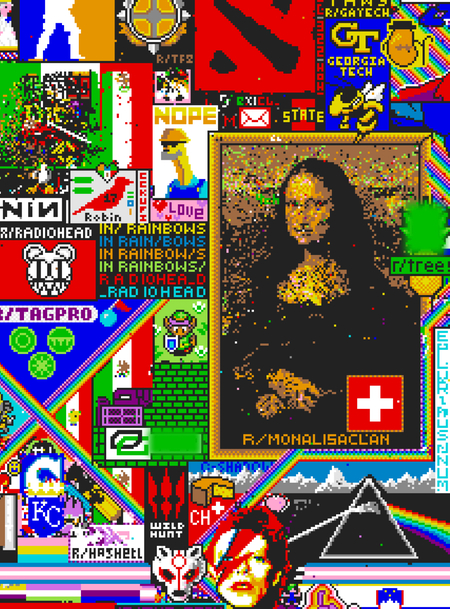
Time-lapse of the formation of the collective digital canvas R/place and its final map based on the project’s archival materials. 2017–2023.
Table of Contents: 1 Visual Research Concept 2 Agreed-Upon Image 3 Image Versus Image 4 Controlled Image 5 Conclusion 6 Bibliography 7 Image Sources
Visual Research Concept
The pixel battle is structured so that authorship is inherently collective in its conception. The canvas is open to everyone; one person places a single pixel and must then wait, meaning no single image can be created in isolation. The conventional understanding of authorship ties a work to the name and the hand that created it. Back in the twenties, surrealists experimented with this link through the game «The Exquisite Corpse, ” where each participant would complete a figure without seeing the others' contributions. In 2005, the Million Dollar Homepage website solved a similar problem differently by selling pixels for a dollar, making the purchaser the author. Reddit proposed a third option, where the pixel is obtained for free, but participants’ time and attention are limited by the rules. This option is examined in this paper.
The research is fundamentally based on Thomas Hobbes’s concept, which describes the transition from a state of nature—where individuals act solely in their own self-interest—to a struggle for resources and the establishment of a sovereign authority. This philosophical framework serves as the principle for categorization, through which the history of pixel battles is examined and the question of ownership over collective creative output is addressed.
The work is divided into three chapters based on types of collective situations. In the first chapter, participants collaborate without a leader and construct an image based on a shared template. In the second chapter, their images compete for the same cells. In the third, it is revealed that the outcome of the struggle is determined by those who control the participants' attention and the canvas’s rules. The main subject is r/place, which ran from 2017 to 2023, and the analysis includes a comparison across different periods. Other platforms are examined as brief comparisons to highlight differences in approaches to collective image creation. Among these is the Russian equivalent of r/place—Pixel Battle on VKontakte—which was included in the study to demonstrate how similar practices evolved within Russian internet culture.
The visual materials were selected based on whether the same section of canvas could be shown in two states to observe the transformation. Therefore, the work includes fragments that are well-documented in press and community atlases, not just the most famous ones.
Large, news-featured paintings are placed next to small sections because the boundary itself illustrates who has the right to a space. This selection process has limits. Since the canvases are closed, we must judge them based on time-lapses, screenshots, and descriptions, meaning the analyzed material is not necessarily typical of the entire event.The textual sources were selected so that each responded to a specific part of the argument. The concept of stigmergy explains how people coordinate through a trace left in the shared environment. Social identity theory shows why the destruction of a group symbol is experienced as a personal blow. Works on power and mass behavior provide language to discuss the leader and the order that emerges from conflict, while the theory of authorial function describes authorship as a system, not as an individual. Academic articles draw on canvas data, preventing conclusions from being based on a single impression. The structure of r/place is described using the developers' own text, and the 2017 interactive archive is used to study specific images and changes on the canvas.
This research addresses the issue of collective authorship in scenarios where an image is created by thousands of participants, each potentially augmenting or subverting another person’s work while operating within platform-set rules. In such a case, who becomes the author of the image, and what occurs when thousands of people gain equal rights to modify a shared canvas? Does this level of freedom lead to chaos, or do participants gradually establish their own order? Can the result of this process be considered art if the image is constantly changing, and its meaning extends beyond the canvas itself?
The hypothesis is that authorship in the pixel battle does not dissolve into the crowd, but rather distributes among participants and those who influence the overall canvas. The freedom to alter the image initially creates conditions for chaos, but gradually participants begin to coalesce around shared symbols and defend them from interference by others. Inequality arises in this process because organized groups and the platform administration possess different capacities to influence the image’s fate. The artistic value of r/place may lie not in the final picture, but in the process itself. The image becomes a testament to the relationships between participants, and the conflicts and cultural phenomena that emerge around it continue to exist even after the canvas is closed.
Design as agreed
In the first chapter, the participants are not yet in conflict, which allows for the display of a minimal mechanism of collective authorship. Heiligens notes stigmergy as coordination where people do not communicate directly but respond to a trace left in a shared environment. The r/place canvas is well-suited for such an experiment because every pixel immediately becomes a message for the next participant. The chapter’s question is what remains of the author when the collective work is sustained only by agreement.
Creating a collective digital canvas in R/place. Coordinates: March 31, 9:00 PM, 10:00 PM, 11:00 PM. Project period—2017–2023.
Sources describe the first hours of 2017 as chaotic, with an disorderly arrangement of pixels. Among the first distinguishable patches was a corner of blue pixels, which came to be called the «Blue Corner.»
Forming a collective digital canvas on R/place. Coordinates: 3/31 at 8:00 PM, 4/1 at 7:00 AM. Blue corner. Project period: 2017–2023.
For this particular fragment, neither a plan nor a leader is necessary, because the rule «place blue next to blue» is sufficient. Each participant reads the preceding person’s trace and extends it, so the author dissolves into the rule itself.
Alongside the angle, there was an homage to Pokémon—a reference to which, in a single color, was insufficient. This franchise commands such a vast audience of fans that the participants immediately united to render the familiar character on canvas. Its recognizability demands a shared vision of the intended outcome. The difference between the two fragments shows that the need for consensus grows proportionally with the complexity of the image. The blue section is content with a trace, whereas the Pokémon requires a clear reference.
Creating a collective digital canvas on R/place. Coordinates: 3/31 at 11:00 PM. Pokémon. Project period: 2017–2023.
Creating a collective digital canvas on R/place. Coordinates: 4/2 5:00, 4/2 13:00, 4/3 20:00. Mona Lisa. Project period—2017–2023.
In the publication’s description, researchers cite reproductions of the «Mona Lisa» and «Starry Night» as examples of work generated from collaborative community projects. In the case of such a piece, the original author is known in advance—Leonardo and Van Gogh—while the group serves as the executors. If the Blue Angle project relied on the principle of authorship, here the concept is sustained by the exemplar, which frees participants from arguing over which pixel is correct. The caption for the fragment remains collective because the executors themselves are anonymous. Foucault linked the function of the author to a name that compiles the works and restricts their interpretation. In these fragments, the classical figure’s name plays that role. It tells the viewer what they are looking at, but nothing about who painted it.In this scenario, the artist’s name does not elevate them to a leader—a role discussed in the third chapter. These works are so well-known that participants perceive them as part of a shared culture and reproduce them of their own volition, rather than under the author’s instruction.
Leonardo da Vinci. Mona Lisa (La Gioconda). c. 1503–1519. Poplar wood, oil. 77 × 53 cm. — Vincent van Gogh. The Starry Night. 1889. Canvas, oil. 73,7 × 92.1 cm.
4/1 4:00 PM — 4/3 8:00 PM Shaping a collective digital canvas on R/place. Coordinates: 4/1 4:00 PM, 4/3 8:00 PM. Mona Lisa. Project Period — 2017–2023.
Forming a collective digital canvas in R/place. Coordinates: 4/2 at 2:00 PM, 4/3 at 8:00 PM. Starry Night. Project period — 2017–2023.
The same sources describe several self-proclaimed «cults» that created and maintained distinct canvas elements, including the multicolored «rainbow road.» The rainbow road is intriguing because it is not an image, but a practice. It has no narrative that could be titled as a painting, so the community itself, unified by the desire to sustain it, becomes the author. Unlike the «Mona Lisa,» there is no definitive model here, but unlike the Blue Corner, there is organization. It is an intermediate state where an agreement is necessary for its preservation. Consequently, the shared authorship rests on the care invested in the fragment.
Forming the collective digital canvas R/place. Coordinates: 4/1 2:00, 4/1 13:00, 4/2 1:00. Rainbow Road. Project period — 2017–2023.
In 2023, the Touhou, osu! , and Hatsune Miku communities recreated the shadow music video «Bad Apple!!» on canvas and presented it as an animation. In 2022, the subreddits immediately began coordinating on Discord, and 2023 shows what that experience led to. Animation requires synchronization not just in space, but also in time—each frame must appear on time and in the correct location. If we use Letterland’s distinction, this is closer to the pole of instruction than any of the previous examples. Three communities with different interests act as a single author. The sample is borrowed, the video has its own creators, so collective authorship does not displace the original source’s name; rather, it operates within it.
Comparing it to its predecessors can help better illustrate what exactly Reddit changed. In «The Exquisite Corpse, ” participants worked blind, and the result remained random; in r/place, everyone sees the entire canvas and can therefore coordinate their actions. The Million Dollar Homepage settled the issue of authorship with money, as mentioned in the concept. In r/place, the expectation between pixels, which ranged from five to twenty minutes in 2017, acts in place of money, meaning the right to leave a trace depends on patience and the number of participants. The question of authorship shifts from property to organization. The one with more participants leaves a greater mark, and the agreement becomes a resource.