01/ INTRODUCTORY INFORMATION
User
A person who perceives an accessory not just as a utilitarian object, but as an element of their style capable of evoking emotion and starting a conversation.Scenario
The clutch is used in the city, at an event, a dinner, an exhibition, or a party—in situations where the bag does not require large capacity, but expressiveness is important.Interaction
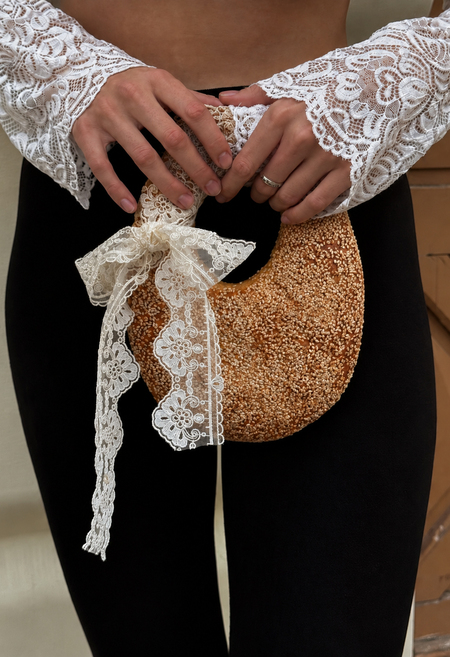
The clutch already incorporates a natural «handle» in its form. This element becomes the means of carrying it: the bag is held by hand at the opening, without needing a separate strap or handle.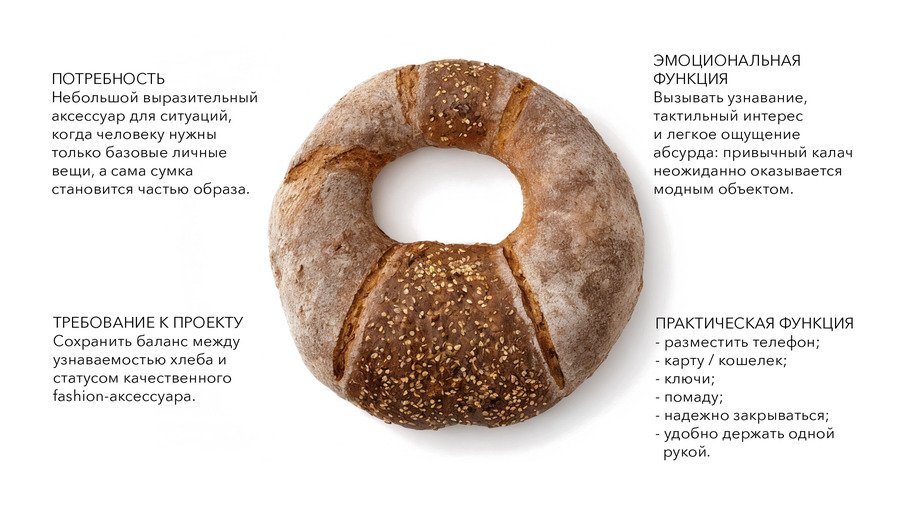
02/ WHY KALACH?
In Paris, the baguette has long become part of the city’s visual code. It is not hidden in a bag; people carry it under their arm, wrapped in paper, or in special cloth and lace covers. This utilitarian item has gradually transformed into almost an accessory.
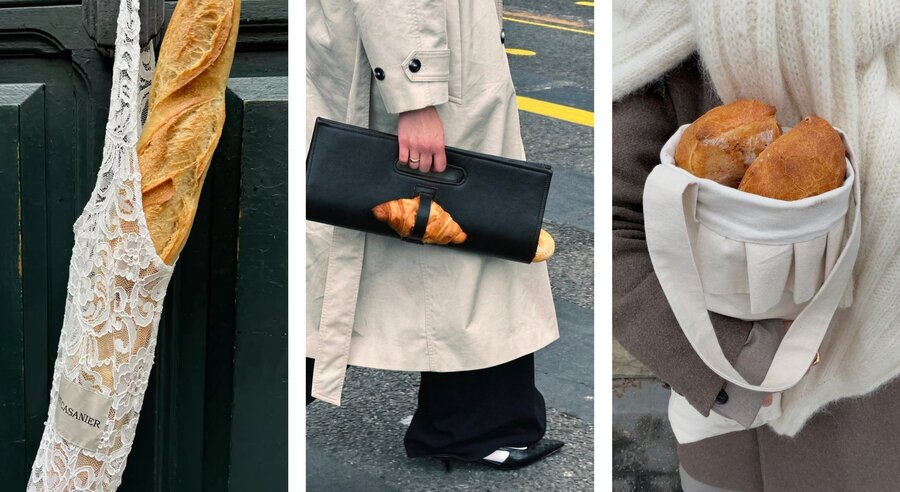
Moscow also has its own portable bread shape—the kalach. The bread form itself already incorporates the ergonomics of a portable object.
For the project, various bread forms familiar to Moscow culture were considered: kalach, saika, and Moskovskaya plyushka. All of them can be interpreted as a local visual code. However, the kalach is interesting because its top portion historically served as a kind of «handle,» making it convenient to hold.
03/ SEARCH AND RESOLUTION
The initial concept for the bag involved a complete replication of the original kalach shape. However, after creating a paper prototype and consulting with a potential manufacturer, it became clear that reproducing the bread’s shape and texture in its current form would be difficult.
Screen printing wouldn’t have looked as striking, nor would it have conveyed the feeling of a crust, whereas 3D printing would have stripped the form of its softness and the sense of «hand craftsmanship.» Therefore, the shape was simplified, and the surface was treated with solid, natural leather. To prevent the bag from looking artificial, the leather is given an additional texture resembling sesame seeds.
04/ MATERIALS AND EXECUTION
skin formation process
To prevent the surface from appearing too uniform or artificial, the body is accented with a decorative texture mimicking sesame seeds. Individual «seeds» are cut from lighter-toned leather using a small shape die or punch, and then manually adhered to the surface with specialized leather adhesive. The slight variation in element placement makes the texture feel more organic and closer to the natural surface of baked goods.
The pocket opening is located on the reverse side of the main body. Since the handle and body of the bag form a single cohesive unit, there is insufficient space in the handle area for convenient access. Relocating the closure to the back allows the bag to maintain a clean silhouette while making its use practical and comfortable.
Clasp on the bag entrance
/05. FROM THE FIRST SAMPLE — TO THE SERIES
We have currently identified a manufacturer with whom we can develop the patterns and produce the first prototype. At this stage, we have determined the form, approximate dimensions, materials, method of wear, zipper placement, and the principle of decorative finishing. We also have an understanding of the intended molding technology for the leather body.
The construction of the wooden template and the checking of the patterns are the most labor-intensive parts of the development process, which are performed only once. The same set can be used for subsequent series.
First Sample Patterns + materials + manufacturing: 15,000 ₽ Timeline: 3–4 daysSubsequent Copies Manufacturing fee: 2,000 ₽ / unit Materials: 3,000–5,000 ₽ (leather, hardware, lace, and decor) Please also factor in packaging, logistics, promotion, and margin costs.Estimated Batch Size: 10 units Production timeline: approximately 2 weeks (not including the time required for the initial sample, lasts, and patterns)