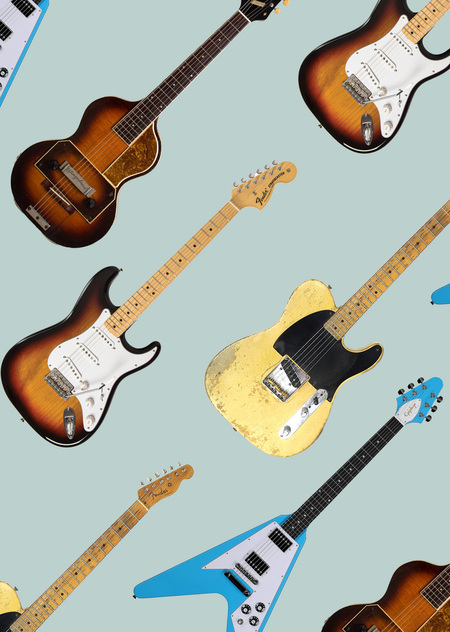
Concept
Electric guitars are one of the symbols of modern music, which is hardly surprising. Electric guitars are used across a wide spectrum of musical genres, and although the direct association is always with rock, jazz, or metal music, this instrument can be heard in countless pop songs, alternative and indie music, country, soul, ambient, and many other genres. Given the genre diversity (especially the multitude of subgenres), as well as musicians' meticulous attention to sound quality and the comfort of their instruments for a specific style of performance, there is a vast array of guitars in different shapes, with varying technical specifications and additional features extending beyond the basic configuration of 6 strings and 22 frets.
However, a question arises—how were all these types of guitars formed, where did certain features originate, and how did they enter mass production? The research hypothesis is that musicians actively influenced the evolution of electric guitar design, either by participating in instrument creation or by inspiring designers to develop new variations of the standard instrument. It is suggested that musicians may have communicated directly with manufacturers, independently modified their guitars, or participated in joint development with instrument designers. On the other hand, there is a theory that many instruments emerged at the initiative of a specific company to satisfy the mass market. The object of this study is the electric guitars themselves, as well as the additional components of their construction. Homemade guitars that were not used in production will not be considered in this research. The subject of the study is the methods by which performers' needs were transformed into changes in the body, neck, electronics, and overall visual aesthetic of the instrument.
The research is structured as a comparative analysis of individual case studies. Each case is examined using the framework: «need identification — participants in the design creation — the final change achieved — dissemination.» This allows for a comparison of different instruments and other guitar components from various periods in the evolution of electric guitars, without focusing undue attention on the personalities of musicians and designers, nor reducing the study to a catalog of guitar models from 1930 to the present day. Sources include interviews with musicians and designers, as well as official «biographies» of the manufacturing companies themselves and historical analytical papers.
Speak up
Historical Note — the Rickenbacker Frying Pan is considered the first electric guitar. Note that this instrument is played in a horizontal position and belongs to the Hawaiian/lap steel guitar family, whose playing style differs from the Spanish style typically associated with guitar playing.
The impetus for electrifying instruments is the musicians' need for greater volume. However, creating a new instrument based solely on the request to «make it louder» is not the only viable solution. In fact, it was the acoustic guitar that was amplified, and turning it into a full-fledged electric guitar would likely have been an overcomplication—the existence of electro-acoustic guitars proves this.
A modern electro-acoustic guitar by Cort. Externally, it is distinguished from a standard guitar only by the presence of a side panel. Inside, it houses hidden pickups.
Some craftsmen simply attach the pickup directly into the hole in the body. This is a modern approach to customizing guitars.
If one considers the predecessors of the electric guitar, another instrument besides the Rickenbacker was the electric archtop. An archtop is essentially the same guitar but features a curved top and most often f-shaped soundholes. Models with round openings are also found. The string saddle on the top is also not glued to the body; it is held solely by the tension of the strings. The Ro-Pat-In Electro Spanish is considered the first electric archtop, released in the same year as the Rickenbacker Frying Pan. In both cases, you can notice the pickup on the front of the instrument. Notably, the body of the Rickenbacker Frying Pan is made of aluminum and lacks the soundholes found on acoustic instruments—the first steps toward a fully electric sound.
The first electric arc top Ro-Pat-In Electro Spanish
The Slingerland Songster 401 is considered the first electric guitar in the classic sense, released in 1936—just four years after the instruments mentioned above. It featured a complete abandonment of the resonator hole, a single pickup, and a relatively flat body.
This guitar was created by Slingerland Musical Instrument Manufacturing Company to make the instrument louder.
Production ran until 1939 and was accompanied by two related models: the Songster 400 Hawaiian, another Hawaiian guitar, and the Songster 401 Spanish, which had a more rounded neck designed for the guitar’s standard playing position.
This marks an important historical stage for electric guitars—the first guitar with a solid wooden body, which later became the standard for the instrument. Because this guitar was designed to be played with an amplifier, the need for a resonant cavity disappeared.
The instrument was sold immediately with an amplifier as part of a set. Nevertheless, the guitar did not achieve widespread fame—its sound and playing feel did not meet the expectations of guitarists of that era, as the guitar was primarily used for rhythmic accompaniment.
The instrument’s construction also influenced its reception—the strings were positioned too high for comfortable play, which likely was inherited from Hawaiian lap guitars that used a metal cylinder for playing.
Slingerland Songster 401
Fender
In the late 1940s, Leo Fender and his team were developing a new guitar tailored for Western Swing performers and dance ensembles in Southern California.Fender himself aimed to refine existing hollow-body electric instruments and simplify the manufacturing process. Furthermore, the goal was to create an instrument that was durable, easily repairable, and suitable for mass production.Prior to working on the electric guitar, Fender was producing Hawaiian electric guitars and amplifiers for them.The first electric guitar was the Esquire—an instrument with a solid wooden body featuring a cutout for access to the upper frets, a neck secured with screws to simplify replacement in case of breakage, and a single bridge pickup based on the Hawaiian guitar’s pickup.In subsequent revisions, the Esquire incorporated a truss rod—a metal bar in the neck that controls the neck’s curvature—a feature driven by performer requests.
Fender Esquire (1950s)
The idea for a simple, easy-to-manufacture and repair instrument went further—it resulted in the Telecaster. It is one of the iconic guitars, still relevant today.The Telecaster (originally called the Broadcaster) received a second pickup with a softer tone, thereby expanding the instrument’s capabilities.
1951 Fender Telecaster
Although the Telecaster represented an advancement over the Esquire, it still had shortcomings. For instance, musician Bill Carson noted discomfort during extended playing due to the instrument’s overly angular body.
Rex Gallion shared a similar observation.
The interaction between the guitar and the musician’s body was a key consideration in developing the next model—musicians articulated the problem, and the designers developed the solution.
Bill Carson actively participated in the development of the new guitar, testing its ergonomics himself—Fender attempted to address the issue by adding a bevel to the body in the area where the musician’s left arm rests and on the back where the guitar presses against the body.
The bevel on the back of the Fender Stratocaster for guitarist comfort
An additional cutaway was also added, creating a second horn. This made playing in the higher register more comfortable than on the preceding Telecaster—the increased space allowed more freedom for the hand in this area of the neck.The «horn» continued to serve as a mounting point for the guitar strap.
Bill Carson and his Fender Stratocaster
Another issue with the Telecaster was that people often stepped on the guitar cables, breaking the connectors on the guitars. Furthermore, Leo Fender himself was against the idea of leaving the jack on the side—it was too obstructive while playing. The solution came from musician and instrument maker George Fullerton; he suggested moving the cable jack from the side to the front, which ultimately became another innovation in the Stratocaster. The final key innovation was the tremolo bar. Bill Carson requested a mechanism that would allow one to raise and lower the pitch, while also returning the strings to their original tuning after releasing the bar, and which would provide a tonal variation of at least a half-tone, allowing one to work with an already sounding chord. Although such levers existed previously and even found commercial success, Leo Fender pursued this idea because he himself had long wished to realize something similar. The unsuccessful attempts to assemble such a system delayed the release of the Stratocaster by almost a year.
Fender Stratocaster
The video below features one of Billy Carson’s songs, a musician who was actively involved in the guitar’s creation. It was his requests that shaped several key characteristics of the Stratocaster.
Gibson
The history of the second iconic guitar is also directly linked to the musician’s active role in its development. In the 1940s, the musician and inventor Les Paul experimented with solid-body instruments. The Log—a prototype assembled from a block with a neck, pickups, and sides attached from a guitar body—was created with the aim of producing an instrument that offered sustained note decay (sustain) and minimized the influence of the resonant body.He proposed this idea to Gibson, a company known for producing premium quality instruments. However, in the 1940s, the company was not willing to take that leap.
Les Paul — The Log