Concept
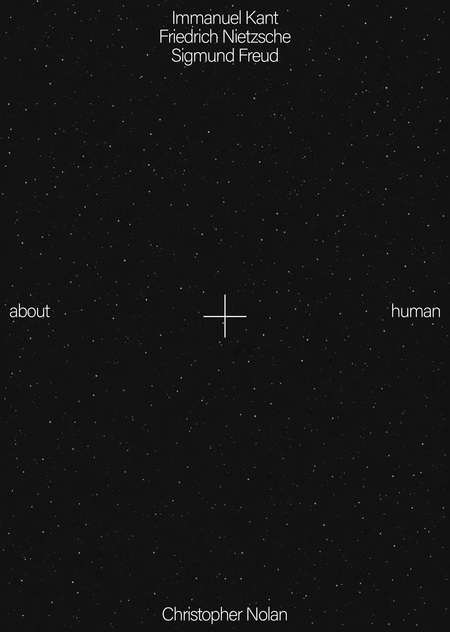
Humans perceive the world from a specific vantage point, yet they are capable of contemplating what they cannot see in its entirety. Their inner life is not solely defined by the present; it retains desires and experiences whose causes are not always clear even to themselves. This study investigates how individuals comprehend their place in the world through these capabilities and limitations. Visual material consists of Christopher Nolan’s «Inception» and «Interstellar»: the space of dreams and the recurring room allow for an examination of the human relationship with time and their own past.
«Interstellar» (directed by Christopher Nolan, 2014).
The foundation of this work is Immanuel Kant’s «Critique of Judgment, ” translated by M. I. Levina. The „Critique of the Beautiful“ allows for an examination of how imagination and reason participate in the perception of form, while the „Critique of the Sublime“ addresses situations where imagination cannot grasp the whole. Kant writes:
Exalted—one capacity for thought that demonstrates a soul capable of transcending any scope of feeling.
Human physical smallness here correlates with the capacity to think beyond what is sensed. The «all and nothing» formula denotes this tension in the work. Sigmund Freud allows us to shift the question of limits toward self-understanding. In his work «The Unconscious,» he describes processes that
…are not ordered chronologically, do not change over time, and are not connected to time at all.
In his theory, the mere passage of time does not negate the impact of past experiences. The past can manifest in present relationships even before that connection is consciously recognized. This raises the question of a soul outside of time. This concept expresses the coexistence of different temporalities within a person’s inner experience; it does not imply the literal existence of the soul across all time, as Freud’s theory suggests.
The question of human transformation is explored through Friedrich Nietzsche:
In humans, what matters is that we are a bridge, not a destination…
The concept of transition and the idea of the superman allow us to view self-overcoming as a reassessment of the values that define a person’s relationship with their own life. The understanding of the reasons behind an action still leaves open the question of whether one should continue acting that way.The key question of this research is: how does a person define their place in the world if neither the world as a whole nor their internal life is given to them completely? The hypothesis is that this understanding develops through connecting partial experiences and reexamining their meaning.The visual sequence is built upon comparing images that share a general reference point but differ in scale, environment, or time. The sections sequentially address perception, memory, the unconscious, and the possibility of change. The texts are selected based on their connection to these questions and are viewed in the context of the artworks; the images serve as material for analysis, not as proof of philosophical propositions.
Structure
Contents1. Concept 1.1. How humans perceive the world 1.2. The measure of man 1.3. Memory and the unity of consciousness 1.4. The unconscious and repetition 1.5. The soul and the experience of time 1.6. Man as a transition 1.7. Presence in the life of another 2. Conclusion 3. List of textual sources 4. List of image and GIF animation sources
How a person perceives the world
«Interstellar» (directed by Christopher Nolan, 2014).
If you look through the slightly ajar door, you first see only the edge of the table, a part of the wall, and a strip of light on the floor. This alone might be enough to identify the room. However, in a tight frame, the strip of light appears as a discrete detail, while in a wide frame, it becomes clear where the light is coming from and how it connects the foreground to the distance. I am interested in two points here. First, the visible allows us to determine what we are looking at. Second, once that is clear, we can pay attention to how the parts of the space relate to each other. For this second question, the general category of «room» is not sufficient.In the Introduction to the «Critique of Judgment» and in the «Analytics of the Beautiful, ” Kant examines the distinction between knowing an object and making an aesthetic judgment. With recognition, we can stop as soon as we associate what we see with a known concept. With contemplation of form, the imagination continues to connect the details, and reason participates in this work without a predetermined rule that would dictate exactly how they should be connected. Kant speaks of cognitive capacities that
…exist in a state of free play, as no specific concept limits their unique mode of knowing.
Comparing the two compositions allows us to see what changes during this transition. In the first image, the door frame occupies a significant portion of the frame and anchors attention near the nearest edge. In the second, the gaze follows the band of light toward the window. The table, wall, and window remain in place. The relationship—which becomes visible to the viewer—changes. In this sense, Kant’s phrase «purposiveness without a purpose» is useful. The arrangement of elements can be perceived as coherent, even though to have such an impression we only need to look at the form and may not be interested in the room’s function.It would be premature to conclude that a wide frame is always superior to a narrow one. While the wide frame conveys more about the space, a tight frame can more clearly reveal the rhythm of verticals or the boundary between light and shadow. Different qualities of the image are important for recognition versus for contemplation. The placement of a person in the world holds a very specific meaning in this chapter. They have a point of view, and changing that perspective allows us to see other relationships within the same subject. The question remains whether this method can lead us to the whole. Sometimes stepping back just a little further is not enough.
The Measure of Man
«Interstellar» (directed by Christopher Nolan, 2014).
When a person stands on the edge of the frame beneath a night sky, their figure immediately provides an approximate measure of what is visible. We know the size of a body, and against that backdrop, the space appears vast. In an image of deep space, this familiar measure vanishes. Numerous points and patches of light become visible, but the size of the image on the screen says almost nothing about the magnitudes and distances they represent. The closer we examine such a photograph, the more we distinguish. This does not yet bring us close to the ability to perceive everything at once.In «Critique of Judgment,» Kant distinguishes between defining magnitude using numbers and assessing it in contemplation. Distance can be expressed numerically, divided, or compared to something else. To experience scale, the imagination must connect what is revealed gradually in contemplation. Kant calls the apprehension of individual parts «intuition» and the attempt to hold them in a single representation «synthesis.» Intuition can continue as new parts are revealed. Synthesis reaches its limit when what has already been noticed begins to slip from attention.
…the connection becomes harder the further the grasping progresses
«Interstellar» (Directed by Christopher Nolan, 2014).
Therefore, one feeling—that what stands before us is something vast—is insufficient for my reflection. The mathematically sublime experience is interesting because the mind demands thinking in terms of the whole, whereas the imagination cannot provide a commensurate image. Kant associates a sense of dissatisfaction with this disparity. Concurrently, it becomes clear that we are capable of conceiving of things we cannot picture, and he links pleasure to this very capacity. The impression is dual because impossibility and possibility relate to different human faculties.This allows us to elaborate on the notion, «we are both everything and nothing.» The word «nothing» here conveys the disproportion between the body and what is revealed to the gaze. The word «everything» refers to the possibility of posing a question about the whole, even when it cannot be presented in a single image. The person remains in the same spatial location, but the perception of the boundaries of their capabilities changes. If the whole can be grasped without a complete representation, it is worth asking whether something similar occurs when a person attempts to understand their entire life.
Memory and the Unity of Consciousness
Two pages, written by the same person at different ages, are placed side-by-side. They can be matched by name and date; one can observe similarities in individual letters and notice how the handwriting has evolved. Authorship of the pages can be established even if the moment one of them was written has long been forgotten. However, these characteristics make it difficult to understand how a person today relates to what they recorded back then. Here, I distinguish between the belonging of an experience to a person and the meaning they assign to that experience when talking about themselves.
In the «Critique of Pure Reason,» Kant formulates the condition for the unity of consciousness:
There must be a way for the expression, «I am thinking, ” to accompany all my conceptions.