Navigation
1. Introduction
2. Research Concept
3. History of the Blue Man Group
4. The Image of the Blue Man
5. The Trumpet as the Basis of the Visual Language
6. The PVC Instrument Design
7. Musical Instrument and Stage Space
8. Drumbone and Form Transformation
9. Collaborative Play as Part of the Image
10. Color as an Extension of Sound
11. The Instrument in Museum Space
12. Conclusion
13. Bibliography
14. Image Sources
Introduction
Blue Man Group merges music, theater, and visual art. Central to the performance are blue characters who explore everyday objects and find unexpected uses for them. Familiar materials transform into musical instruments, and simple actions become theatrical events.
I was intrigued by how closely sound and the appearance of the instrument are linked within this project. The constructions made from plastic pipes immediately capture attention with their scale and unusual form. Through them, one can trace the performers’ movements and observe how the musical action is generated.
In this study, I examine the Blue Man Group’s instruments as design objects. Their structure influences the stage composition, the characters' behavior, and the audience’s perception of the performance.
Research Concept
The central question of this research is how the structure of a musical instrument forms the visual language of Blue Man Group. I hypothesize that the project’s recognizability is built upon the interplay of several elements. The blue makeup distinguishes the performers, the horns organize the space, and the performers' movements connect the object’s form to the sound. For analysis, I have selected photographs of performances, close-ups of the instruments, and materials from a museum exhibition. Primary focus is placed on the stationary PVC Instrument and the movable Drumbone. Comparing these constructions allows us to trace how a single material generates different modes of play and different stage personas.
The History of the Blue Man Group
The project emerged in New York in 1987, founded by Chris Wenk, Matt Goldman, and Phil Stanton. Initially, Blue Man Group developed within the realm of experimental performance. In 1991, they began performing at the Astor Place Theatre, which became a significant chapter in the group’s history. news.cision.com
Even in its early iteration, the core principles guiding its future development are discernible. Uniform makeup unites the performers, and the absence of speech directs the audience’s attention to gaze, gesture, and interaction with objects.
A group photograph reveals that the stage composition is built around shared action. The audience follows the dynamics between the characters and the instrument, which occupies a substantial portion of the space.
The Image of the Blue Human
Blue makeup creates the sense of an archetypal character. The face retains human expression, but it feels unfamiliar due to the solid color and the absence of visible hair. Against this backdrop, the eyes and the direction of the gaze become particularly noticeable.
Black clothing minimizes distracting details. On a dark stage, faces and hands stand out more prominently. A visual link emerges between observation and action. The character first examines the object, then touches it and tests what can be done with it.
In the chosen photograph, the overall color unites the three performers, but variations in their poses preserve each individual’s uniqueness. As a result, the group appears as a unified whole within which reactions are constantly exchanged.
The Pipe as the Foundation of Visual Language
In the Blue Man Group instruments, the pipe becomes a repeating module. Straight sections connect with bends, and open perforations alternate with dense clusters of parts. Complex spatial structures emerge from simple elements.
When looking at the close-up, the eye gradually moves from one connection to the next. The lines of the pipes define directions, intersecting and returning. Even an inanimate tool creates a sense of movement.
Retaining recognizable material makes the construction particularly expressive. The viewer sees ordinary plastic pipes, but their quantity and arrangement alter the conventional perception of the object. The musical instrument begins to resemble a sculpture or an experimental machine.
PVC Instrument Device
The PVC Instrument consists of a system of pipes made from polyvinyl chloride. The dimensions and configuration of the air channels are crucial for its sound. The percussive playing style allows the instrument to be used for executing both rhythmic and melodic patterns. Blue Man Group members specifically note the importance of pipe length and diameter when tuning the instrument.
The external complexity of the instrument is linked to its construction. Long sections must be housed in a limited space, so the pipes are bent and connected to one another.
A close-up view helps reveal this relationship. Details that appear as decorative interlacing from a distance are actually parts of a working structure. The instrument’s form becomes the visible outcome of the search for the desired sound.
Musical Instrument and Stage Space
The static instrument defines the positioning of the performers. Its elongated form distributes action horizontally, and open sections allow the audience to see the hands and faces of the characters.
In the photograph, the structure occupies the space between the people during the performance. It connects them into a unified composition while simultaneously delineating separate areas of focus. The viewer’s attention moves along with the performers' gestures.
The Blue Man Group materials also note that the placement of pipes considers visual expressiveness. Furthermore, the sequence of notes may differ from the conventional chromatic organization of a piano keyboard. This demonstrates that the visual appearance and the musical objective are developed in tandem.
Drumbone and Shape Change
Drumbone presents an alternative approach to working with tubing. Its movable parts allow the performer to alter the length of the air channel during a performance. This principle is reminiscent of a trumpet’s mechanism, yet the sound is produced through striking. palacetheaterct.org
Unlike a static construction, Drumbone is constantly shifting its form. The tubes extend, slide, and rotate. The movement required to play the instrument simultaneously becomes part of the stage performance.
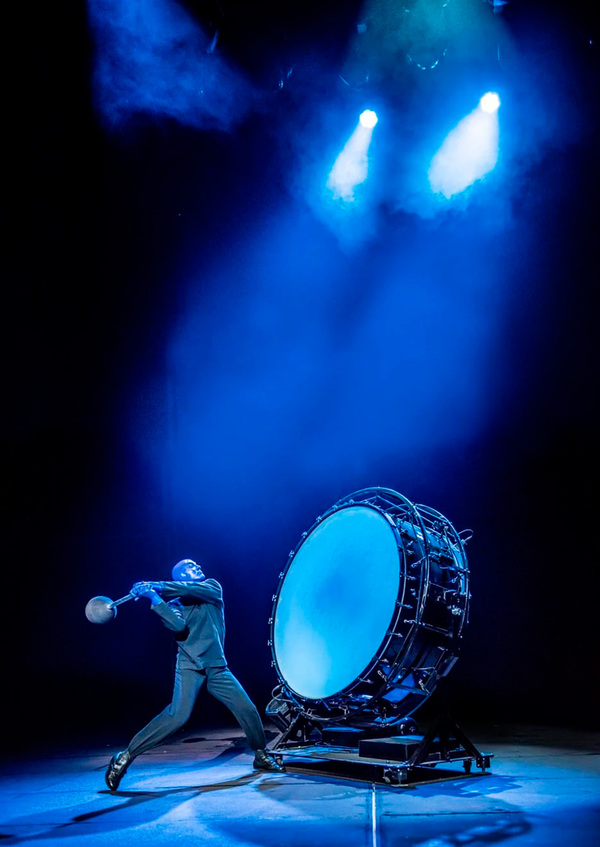
Comparing the photographs reveals that the instrument is difficult to separate from the performers' poses. Its form exists in interaction with the human body. Therefore, Drumbone can be viewed as a dynamic construction that defines the choreography of the musical piece.