Analysis
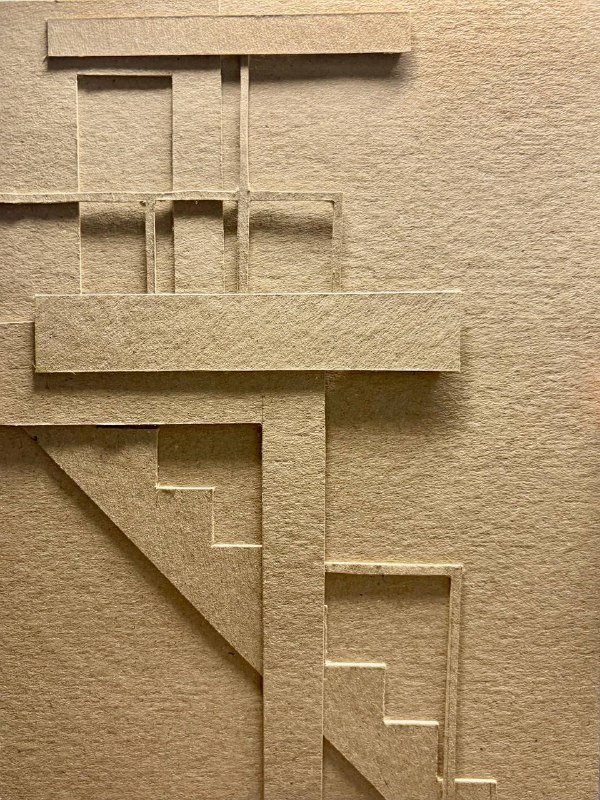
The balcony railing in E-1027 is not a mass, but a filter. The thin uprights and horizontals do not so much support as they modulate light and gaze—the balcony remains open yet gains a defined boundary.
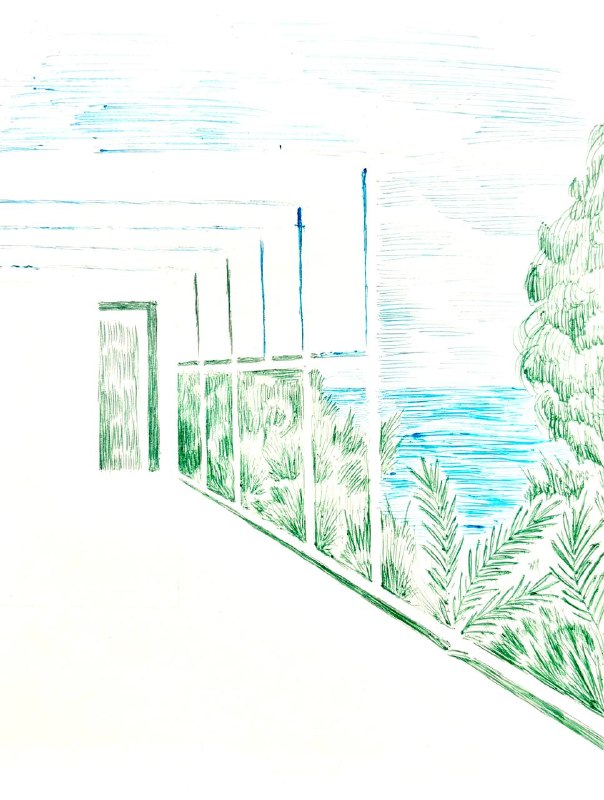
The light in E-1027 doesn’t just enter—it filters through layers. Screens before the window transform the landscape into a series of frames rather than a single panorama. The boundary between inside and outside becomes dynamic: by shifting the screens, one can change both the light and the composition of the view.
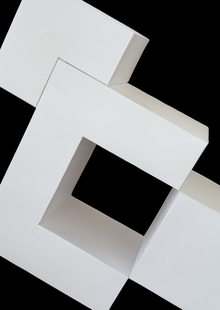
The facade of E-1027 is built on the rhythm of mass and void: solid wall sections are balanced by ribbon windows and a lattice balcony. The void here is not a «hole,» but an active element of the composition.
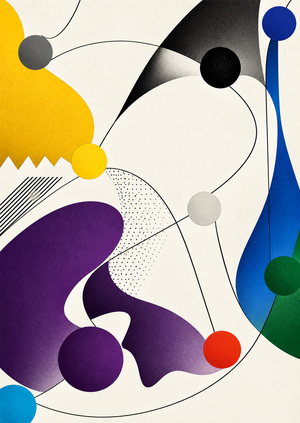
Screens in E-1027 create an intermediary zone: the person sits not by the window, but between the window and the screen. This positioning offers both security and a view. The collage illustrates that a boundary is not a line, but a space in which one can reside.
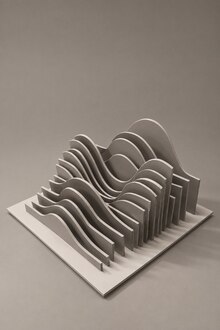
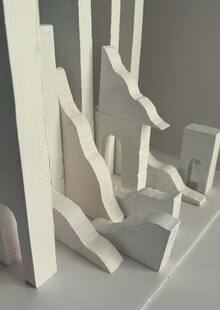
The screen in E-1027 is not a wall—it is a filter. It does not completely enclose the space; rather, it modulates the light, gaze, and air. In this model, it is evident that the boundary can be porous: it is composed of numerous elements separated by voids.
Plan and section E-1027 illustrate that the house functions as a journey, not merely a collection of rooms. Entry is deliberately delayed—first through an atrium, then around a turn, and finally into an unveiling. The space alternates between compression (hallways, staircases) and expansion (living room, terrace).
Art Object
How does a delay before spatial reveal influence perception?
Hypothesis: moderately increasing thresholds enhances interest and engagement. If there are too many barriers, they are perceived as obstacles rather than invitations.
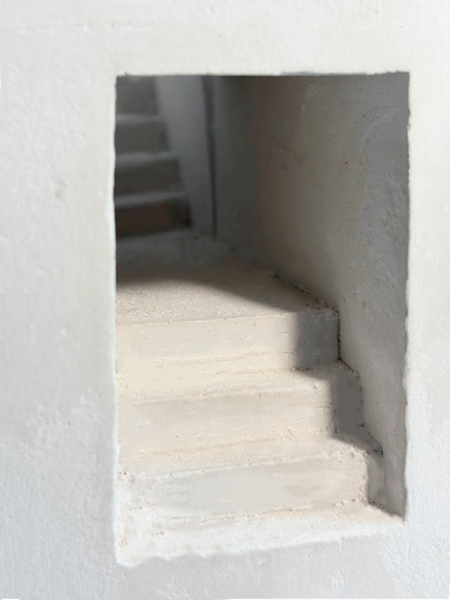
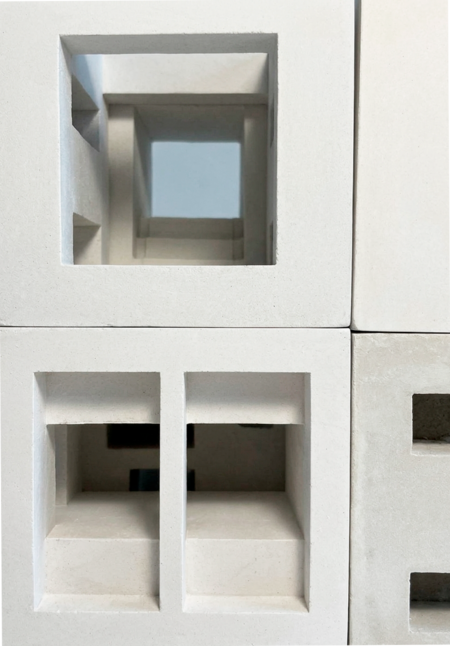
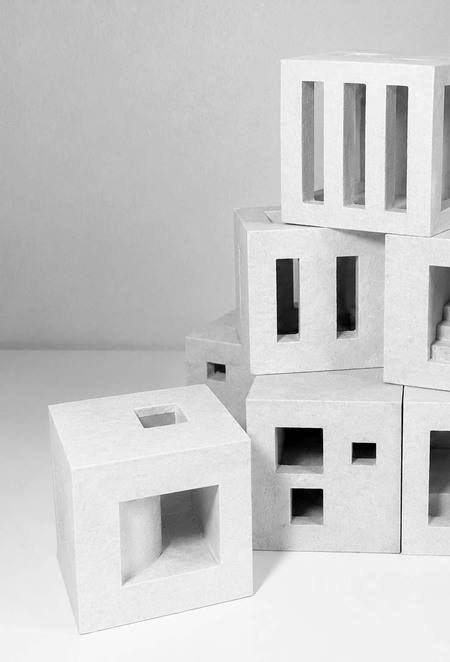
Eight plaster cubes assemble into one large object. Each cube is configured differently: staircases, passages, niches, and openings emerge. By rearranging the cubes, the viewer constructs a labyrinth, where at times atria arise and other times dead ends appear. This is a kinetic art object that invites the audience not merely to observe, but to touch, imagine, and explore.