RUBRICATOR:
— general theoretical part — presenting the brand to a wider audience — presentation for a professional audience — brand strategy — bibliography and list of image sources

GENERAL THEORETICAL PART

Communication Theory in Design-Driven Fashion Branding
Within communication theory, communication is understood not as the transmission of information, but as a process of meaning production. Meaning is not contained in the message or the object itself; it emerges through interaction between form, context, and audience interpretation.
This approach is crucial for design-driven fashion branding, as design operates not through explanation but through non-verbal communicative elements: form, material, visual structure, repetition, and presence in everyday environments. According to communication theory, these elements are not neutral; they are communicative, as they guide interpretation and shape meaning.
Communication theory also rejects the linear model of «sender–message–receiver» and emphasizes the active role of the audience. In fashion branding, this means that the brand does not directly control meaning. Meaning is formed through wearing, use, and the social recognition of the product.
Thus, communication theory makes it possible to view a fashion brand as a communicative system, in which: design functions as the primary carrier of communication, meaning remains open and interpretative, communication unfolds over time rather than at the moment of message delivery.
This makes communication theory a practical tool for analyzing and designing brands that operate through design, rather than through direct messages or persuasion.
PRESENTING THE BRAND TO A WIDER AUDIENCE
The mission of 8FENOMEN is to create clothing and accessories as a communication medium that allows people to visually express their personal philosophy, values, and inner states in everyday life.
The brand does not aim to persuade or instruct.
Instead, it provides visual and textual fragments that users interpret and complete themselves.
This approach follows the interpretive tradition of communication theory, where meaning emerges through participation rather than control.
For a wider audience, the brand presents itself as a space for self-expression, where clothing and accessories help communicate personal philosophy without words.
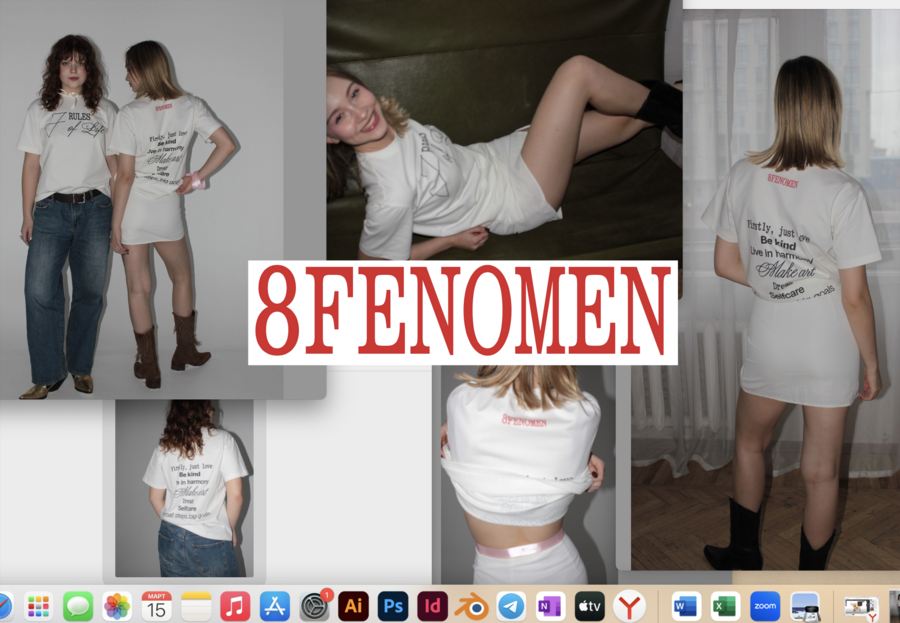
8FENOMEN offers thoughtfully designed pieces with a calm visual language that fit easily into everyday life while allowing a sense of individuality. The brand focuses not on trends but on meaning, creating limited collections in which every detail supports a feeling of personal choice and emotional resonance.
The brand demonstrates that meaning emerges not only from the object itself but through its circulation and presentation within social and digital environments. Clothing, imagery, packaging, and social media content operate together as a unified communication channel, reinforcing interpretive engagement.
This approach reflects the understanding of communication as a non-linear, systemic process in which meaning is co-created by the designer, the wearer, and the observer.
PRESENTATION FOR A PROFESSIONAL AUDIENCE
8FENOMEN is a fashion and lifestyle brand that positions clothing and accessories as communicative artifacts rather than purely functional products.
The brand is built around the idea that personal philosophy can be expressed through everyday objects, not only through language.
For a professional audience, 8FENOMEN should be understood not simply as a fashion brand, but as a communication framework, where design, use, and interpretation play a central role in meaning production.
VISUAL LANGUAGE
In 8FENOMEN, design was not added after strategy as a visual layer. From the beginning, it functioned as the primary communicative tool of the brand.
Visual decisions were treated as communicative decisions: they shape how the brand is perceived, experienced, and interpreted. The brand deliberately avoids expressive decoration or visual excess, choosing restraint and clarity to create space for meaning rather than explanation.
The visual language of 8FENOMEN is based on:
— minimal forms, — limited color palettes, — controlled typography, — short textual phrases.
These choices prevent visual overload and avoid fixed or literal readings. From a communication perspective, design functions as an open structure:
— it does not dictate meaning, — it invites interpretation, — it adapts to different personal and cultural contexts.
Design therefore operates as a framework, not as a message.
A semiotic perspective applies to 8FENOMEN only partially.
The brand does not build a complex sign system and does not rely on symbols, icons, or visual metaphors that require decoding. Instead, its design is reduced to a logo and short phrases.
However, these minimal elements still perform a sign function. Once a phrase is placed on clothing and repeated across products, it no longer operates as spoken language. It becomes a meaning-bearing form: — The phrases do not inform or instruct. — They indicate states, attitudes, or values. — Meaning remains open and connotative.
Semiotics here supports interpretation but does not dominate communication.